In 1944, Maya Hayuk’s parents fled war-torn Ukraine. Eight decades later, their American-born daughter returned to her ancestral homeland by choice. Over the years, she has become one of the most prominent American artists of Ukrainian descent, with her work featured in museum collections and exhibitions across the US, Canada, France, the Netherlands, Brazil, and Chile. She has served as a guest lecturer at prestigious universities, curated art projects, and collaborated with renowned musicians.
Yellow Blue journalist Roksana Rublevska shares Hayuk’s story—tracing how a child of the post-war diaspora developed her unique artistic voice, achieved global acclaim, and, following the full-scale Russian invasion, returned and rediscovered Ukraine.
1
The story of Ukrainian-American artist Maya Hayuk began long before she was born—rooted in the fate of two Ukrainian families displaced by the Second World War. Her father was born in 1939 in the Volyn region, and her mother that same year in the Ivano-Frankivsk region. In 1944, as the Soviet front advanced westward, thousands of Ukrainians fled their homes. Fearing Soviet repressions for real or perceived ties to the Ukrainian liberation movement, they retreated alongside German troops. Both of Hayuk’s families—strangers to each other at the time—embarked on this very path. It was a remarkably common narrative for the post-war Ukrainian diaspora.
Maya’s father’s family was detained by the Germans and sent to a forced labor camp. After American troops liberated the camp in 1945, both families eventually made their way to the United States through different routes. Maya’s future parents were not even five years old at the time. They later met as students at the City College of New York (CCNY), where both eventually stayed on as faculty members. Her father specialized in the geography of the Soviet Union, while her mother taught psychology. The young family later relocated to Baltimore, where Maya was born in 1969.
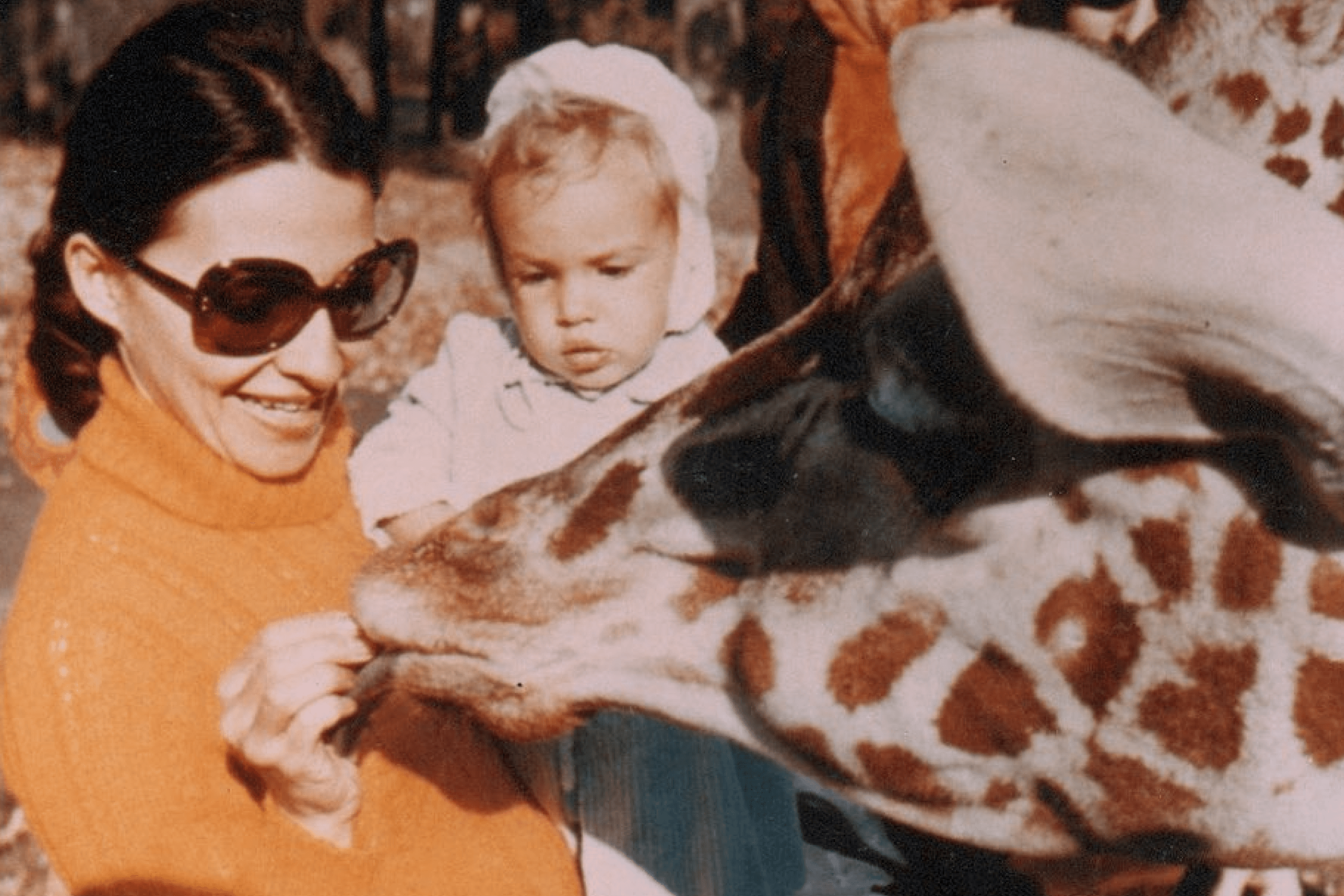
Ukrainian was her first language, spoken exclusively at home; she only began learning English after starting kindergarten. Maya’s family epitomized the American middle class, grounded in an unwavering belief that education was the ultimate investment.
Every Saturday, Maya attended Plast. For the children of the Ukrainian diaspora, this scouting organization was much more than a youth camp: it was an institution that helped preserve the language, culture, and historical memory of a generation raised far from their homeland. "From the age of eight to eighteen, I was in Plast—it was my tangible piece of Ukraine," Maya recalls. "It was the best time of my life. I was surrounded by kids whose families had survived the exact same war, the same flight, the same trauma. We understood each other without saying a word."
Outside of these camps, Maya immersed herself in American youth culture, discovering punk rock and new wave. At the time, she had no idea that this unexpected fusion of Ukrainian tradition and American counterculture would eventually become the foundation of her distinct visual language.
By the time she reached adulthood, Maya had traveled across much of Europe and the USSR. Her mother had traded her academic career to become a travel agent specializing in European routes. Hayuk visited her parents’ homeland for the first time in 1986, just months before the Chornobyl nuclear disaster. Her mother had organized an extensive Soviet tour for Maya and two other young women from the Ukrainian diaspora. After journeying through various Soviet republics, the trio spent two months at Odesa University studying Ukrainian history.
The romantic expectations of this first pilgrimage to her ancestral home were quickly shattered by reality. "We thought we’d be studying alongside Ukrainian students," Maya recalls. "Instead, they set up isolated classes for us. The professor taught Ukrainian history in Russian—he simply didn't speak Ukrainian." For a young woman raised in a Ukrainian-speaking household, it was a profound cultural shock.
Driven by a thirst for authentic experience, Maya and her two friends practically lived out a spy thriller. Dressing down to disguise their American identities, they went rogue, sneaking onto a night train to Lviv without authorization. Flouting Soviet regulations for foreigners carried the risk of deportation and a permanent entry ban, but the gamble felt too important to pass up.
In Lviv, Maya serendipitously crashed the birthday party of a young musician named Taras Chubay, the future frontman of the Ukrainian rock scene. This chance encounter plunged her into a vibrant underground world where art, political discourse, and counterculture seamlessly intertwined. Returning to the US, Hayuk knew with absolute certainty that she wanted to dedicate her life to art; she just needed to find the right incubator. She enrolled in the Interrelated Media program at the Massachusetts College of Art and Design in Boston, one of the nation's oldest public art institutions.
At first, Maya seriously considered a career in photojournalism, setting her sights on National Geographic. "I asked a professor who shot for them how to break in," she says. "He told me that taking good photos wasn't enough; you had to become embedded in their community." Later, that same professor invited Maya to accompany him on an assignment to Ukraine. He was planning a piece on youth drug addiction. Hayuk turned him down.
"I knew it was an important issue, but Ukraine had just gained its independence," she reflects today. "The world knew almost nothing about it. Instead of spotlighting the artists, musicians, entrepreneurs, and activists building a new nation, he wanted to do a story on drug addicts." That conversation was a turning point, pushing Hayuk entirely toward the independent art scene. "I realized I didn't need National Geographic. I wanted to find my own people, my own community. And eventually, I did."
3
In the early 1990s, Maya Hayuk relocated to San Francisco, then a thriving epicenter of American alternative culture. For the first time, she found herself immersed in a community of artists operating almost entirely outside the traditional museum and gallery circuits. They painted murals, hosted underground exhibitions in abandoned buildings, and transformed the urban landscape itself into a canvas.
Hayuk seamlessly folded into this scene. She shot rock and indie musicians on film, designed their album covers, painted on the side, and tended bar to make ends meet. Eventually, she landed a job in a photo lab before stepping up as the art director for one of the pioneer websites dedicated to surf, skate, and snowboard culture.
In 1998, Maya was invited to her first group exhibition. While the organizers expected photography, she showed up with her canvases. The venue was unconventional: a daytime gallery that morphed into an electronic music club after dark. "Everyone was shocked—'Wait, you paint too?'" Maya recalls. "My first piece sold for $100. I couldn’t fathom it. Someone had just paid half my monthly rent for a painting I made. My work actually resonated with someone."
San Francisco ingrained in Hayuk the value of artistic solidarity. "Another artist gave me a piece of advice: if you want to show your work, find the artists you admire. Organize joint exhibitions. Support one another. When they get an opportunity, they’ll bring you in. When you get one, you do the same."
But by the early 2000s, the city's fabric began to shift. The initial dot-com boom sent housing costs skyrocketing. The derelict warehouses and factories that served as artist studios became prohibitively expensive, driving creatives out of San Francisco. In 2001, just months after the September 11 attacks, Hayuk relocated to New York. Paradoxically, the tragedy had made the city temporarily more accessible: rent plummeted, and the creative pulse was slowly returning to Brooklyn.
By day, Maya worked as a photographer and painter; by night, she poured drinks. She’d bike home around 7:00 AM, catch a few hours of sleep, and start all over again. Increasingly, Hayuk gravitated toward street art and large-scale murals. Thanks to her reputation from San Francisco, commissions to paint walls started rolling in almost immediately.
Maya quickly sensed the shifting tides in photography. "People were buying digital cameras and were willing to shoot for free—especially students," she notes. Painting, once her private sanctuary, began taking center stage. Within a few years, her prolific output of murals had put her name on the map across the US.
In 2004, a major vodka brand—one boasting a legacy of collaborations with Andy Warhol and Keith Haring—tapped Hayuk and a select group of peers for a new global ad campaign. Her artwork anchored massive installations and promotional materials, marking her first truly large-scale commercial project.
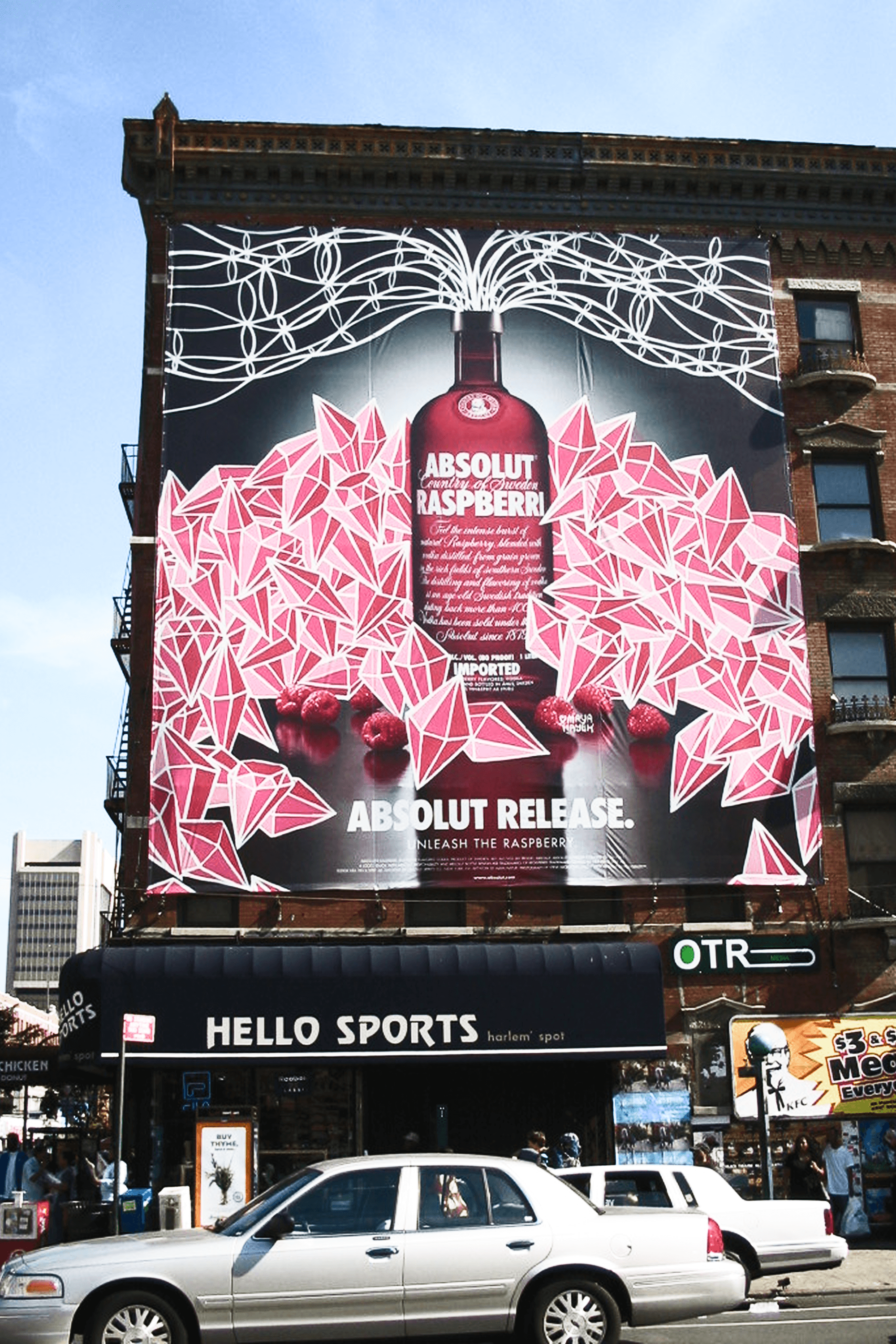
During a meeting, one of the company’s executives delivered a message she carries with her to this day: "We are paying you this money so you can stop working for everyone else and dedicate yourselves entirely to your art."
The very next day, Maya quit her bartending job. From that moment on, art became her sole, lifelong pursuit.
4
Hayuk has frequently remarked that she never viewed art as a mere profession; for her, it is a mode of existence. This unwavering dedication led her to another profound realization early on: she didn't want to have children. In the 1990s, such a choice was practically an act of defiance for a woman, particularly within the traditional Ukrainian diaspora where family remained a paramount value.
"When a man says he doesn't want kids, no one bats an eye. But when a woman says it, people immediately ask, 'What’s wrong with you?'" Maya notes with a touch of irony.
Explaining this deeply personal decision to her parents and partners was never easy. It ultimately ended a ten-year relationship with a partner who wanted a family while she didn't. Other romances followed, almost exclusively with fellow artists, but the outcome was invariably the same: the men eventually moved on to become fathers. "I know my ex-boyfriends' kids, and I’m genuinely happy for them," she reflects. "It just wasn't supposed to be my path."
After 2004, Hayuk’s career became a whirlwind of constant movement between New York, Berlin, Brussels, and Stockholm. She produced large-scale murals, mounted solo exhibitions, developed museum projects, and guest-lectured at prestigious universities. Her artistic style evolved dramatically during this period. Moving away from her early figurative work and photography, she transitioned into expansive geometric abstractions. She drew profound inspiration from Ukrainian pysanky, traditional folk embroidery, woven textiles, mandalas, and Mexican weaving. However, Maya never sought to replicate folk art literally. Instead, she is captivated by rhythm, symmetry, the repetition of form, and the dynamic interplay between these elements rather than individual motifs or symbols.
Hayuk views her solitary studio practice and her highly public mural work as opposing yet equally vital pillars of her life's calling. Her creative process is deeply intuitive; she rarely plans the final composition in advance. Starting with a nearly blank canvas, she allows the piece to dictate its own direction, letting the work guide her next move.
From 2005 to 2011, Hayuk curated This Wall Could Be Your Life, a project adorning the facades of Brooklyn's legendary Monster Island / Secret Project Robot art space. During that era, the venue was a pulsating hub of New York’s independent art scene, a place where emerging talents debuted alongside established figures. For Hayuk, spearheading this project marked a pivotal shift: she was no longer merely navigating the art world; she was actively shaping it.
5
During her time in San Francisco, Hayuk photographed musicians, designed album art and posters, and crafted stage sets. She later collaborated with acts like Rye Rye/M.I.A., TV on the Radio, The Flaming Lips, Devendra Banhart, Animal Collective, and dozens more. Ukrainian music, however, had largely remained off her radar—until 2022. The full-scale invasion prompted her to discover an entire generation of Ukrainian artists. "They sing about freedom. About independence. About the right to be yourself," she says. "It reminds me of 1980s and 1990s American hip-hop. Back then, African American musicians were speaking out about their dignity, their right to a voice, and their freedom. Today, Ukrainian musicians are saying the exact same things."
In 2022, Hayuk launched Tryzub (Trident), an initiative that evolved from a public art performance into a sweeping series of murals, silkscreen prints, graffiti art, and workshops. Partnering with the Unbroken National Rehabilitation Center, she organizes public events and art therapy sessions for the children of Ukrainian defenders. The project's impact has resonated far beyond Ukraine's borders. That same year, she flew from New York to France for the Urbain.es festival, where she painted a massive mural of the Ukrainian trident in the national colors across the commune of Roubaix as a powerful statement of solidarity. Today, Maya produces charity print runs and hand-painted T-shirts, funneling the proceeds to Ukrainian humanitarian initiatives like Razom for Ukraine and Rescue Now.
After returning to Lviv in 2024 for the first time in nearly four decades, now Hayuk visits the city every summer.