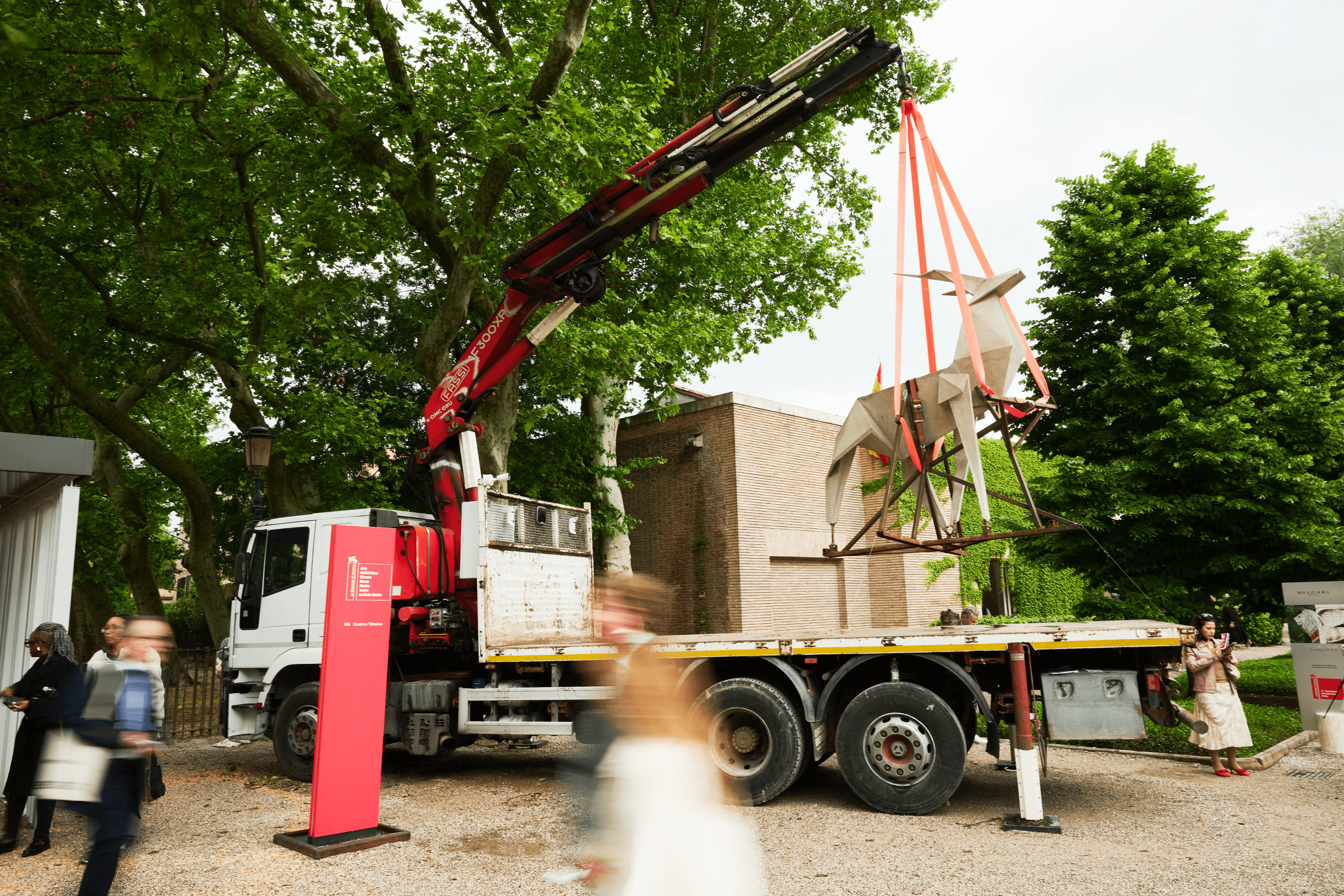
The 61st Venice Biennale, the world’s most prestigious art forum, opened on May 9. Ukraine’s pavilion features “Security Guarantees"—an origami-style deer sculpture crafted from materials salvaged from the Russian-ravaged city of Pokrovsk. The piece now stands where a Soviet nuclear bomber monument once loomed until 2019. The project’s concept took shape in 2024, following the deer’s successful evacuation from the frontline.
How Russia Returned to the Biennale
- In March 2026, Vladimir Putin’s special representative for international cultural cooperation and former Minister of Culture, Mikhail Shvydkoy, announced that the Russian pavilion would open alongside all others. Russia had not participated in the exhibition since the beginning of the full-scale invasion in February 2022.
- The Italian government and the European Union spoke out against Russia’s participation. However, the President of the Biennale, Pietrangelo Buttafuoco, stated that the event is “open to everyone.” According to Italian journalists, it was Buttafuoco who lobbied for Russia’s return.
- On April 30, nine days before the exhibition’s opening, the International Jury of the 61st Venice Biennale announced a collective resignation due to the participation of Russia and Israel.
- Because the EU has implemented sanctions prohibiting the funding of Russian state institutions or direct cooperation with them, the Russian pavilion will not operate throughout the entire duration of the exhibition. It opened only for the press preview from May 6 to May 8.
On numerous screens there is a continuous road. And on this road, a truck is driving.
It drives across European Square in Kyiv. Through the cobblestone streets of Lviv. Along the tram tracks in Brussels. Through the Museum Quarter in Vienna. Along a high-speed highway in France. And along the front line in Ukraine.
The truck begins its journey back in August 2024 in Pokrovsk. While Russian troops just ten kilometers from the city relentlessly douse it with fire, brawny workers carefully place a deer sculpture onto the truck. Having just seen the piece removed from its pedestal, the renowned artist Zhanna Kadyrova watched the process with visible nerves.
She would feel that same anxiety on May 7, 2026, at the Ukrainian pavilion of the 61st Venice Biennale. The deer’s long journey to reach her has been captured on screens that broadcast video non-stop. These videos are part of the exhibition “Security Guarantees,” where the deer is the central composition. It traveled nearly seven thousand kilometers to Venice and will remain here until November.
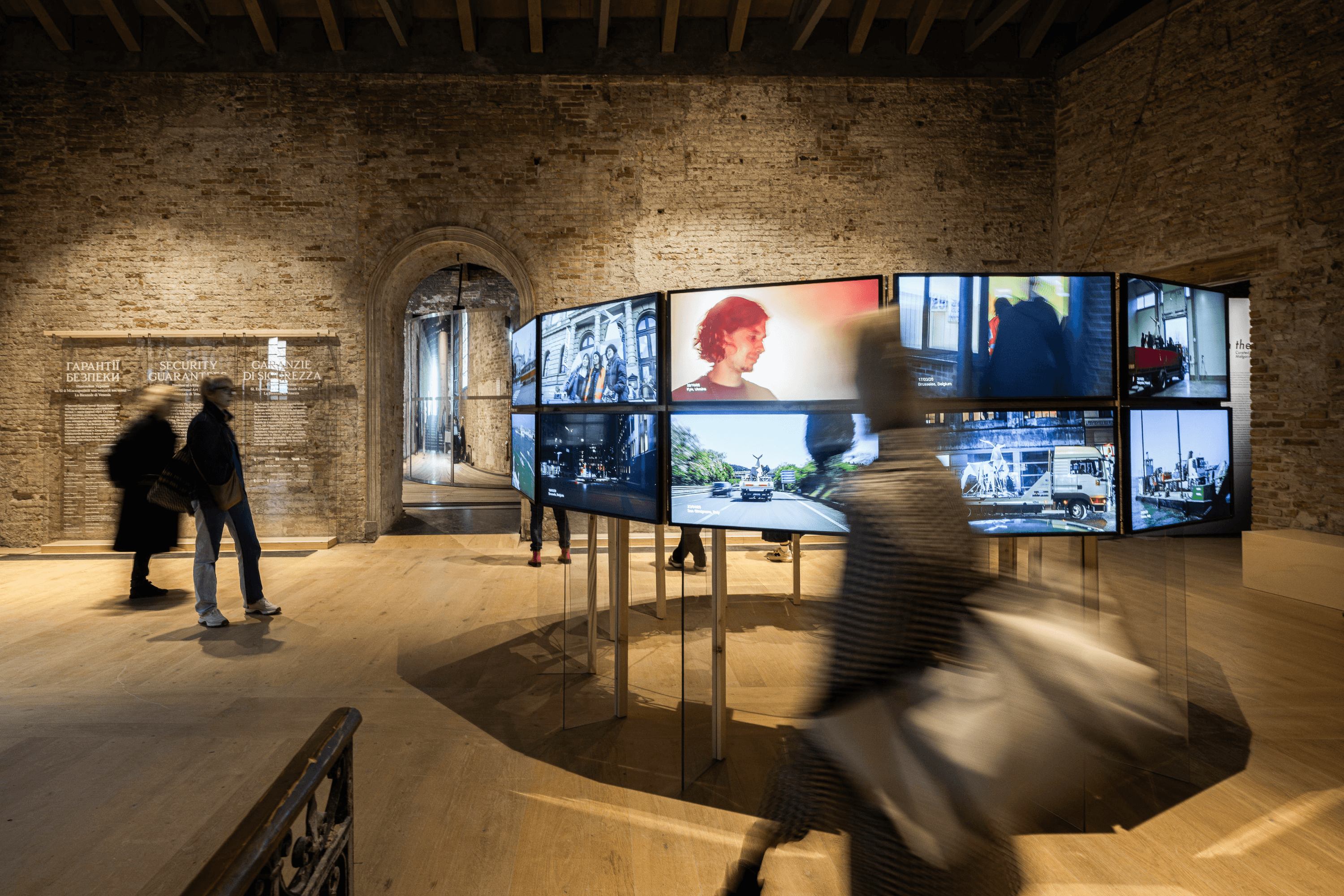
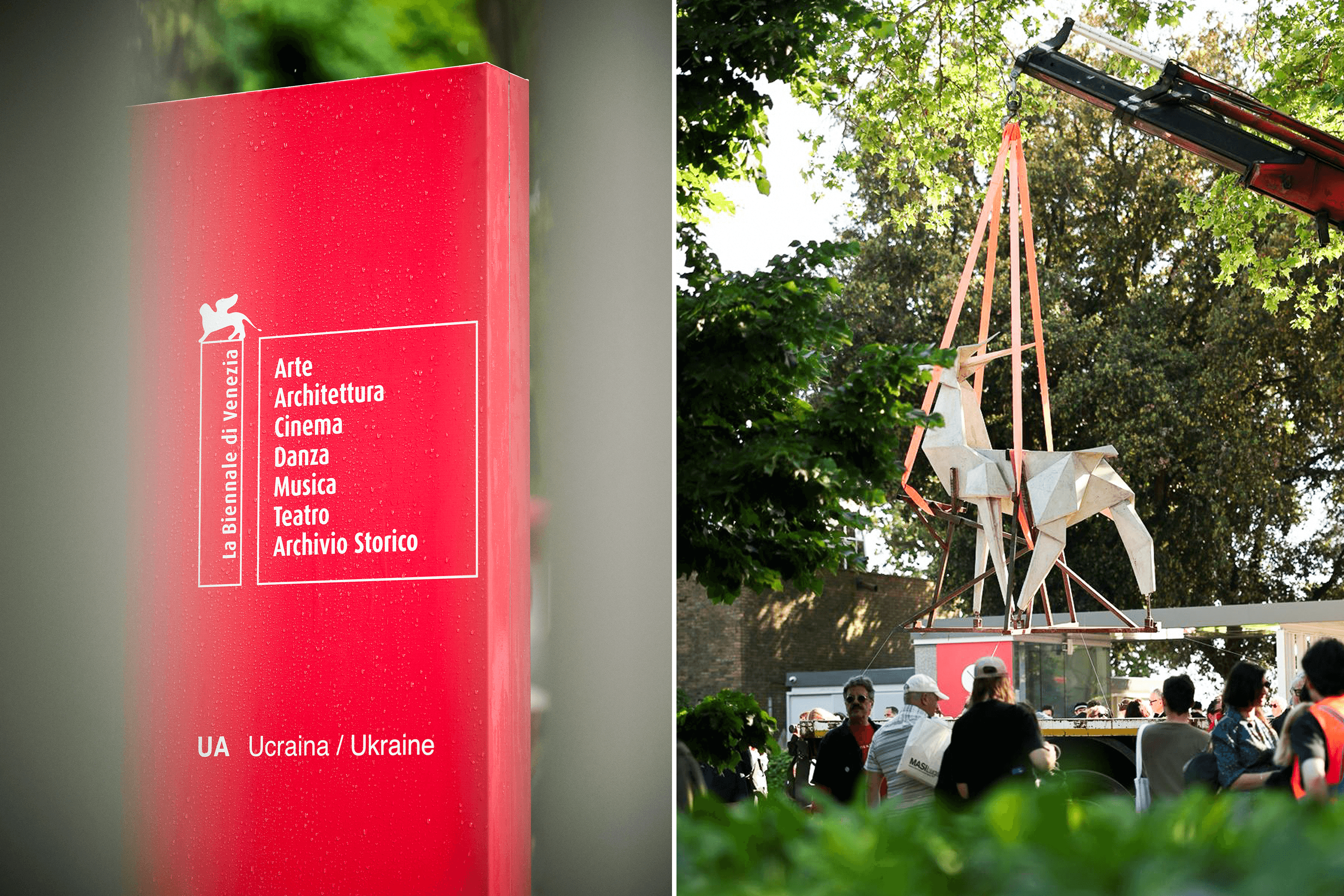
Screens in the Ukrainian Pavilion at the Venice Biennale show the journey of Zhanna Kadyrova’s sculpture from Pokrovsk to Venice. Photo: Valentyna Rostovikova for Ukrainian Pavilion / YB 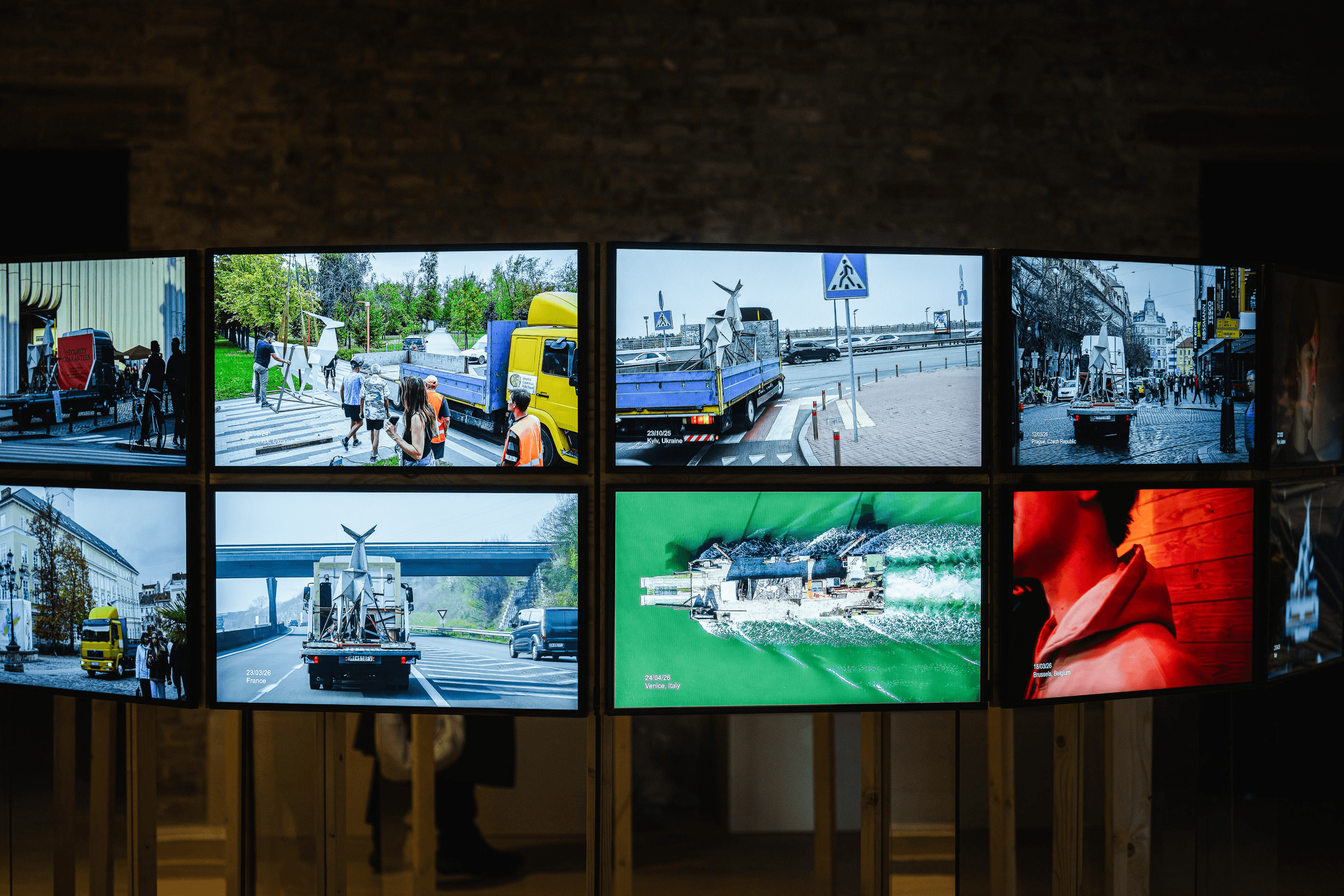
Photo: Valentyna Rostovikova for Ukrainian Pavilion / YB 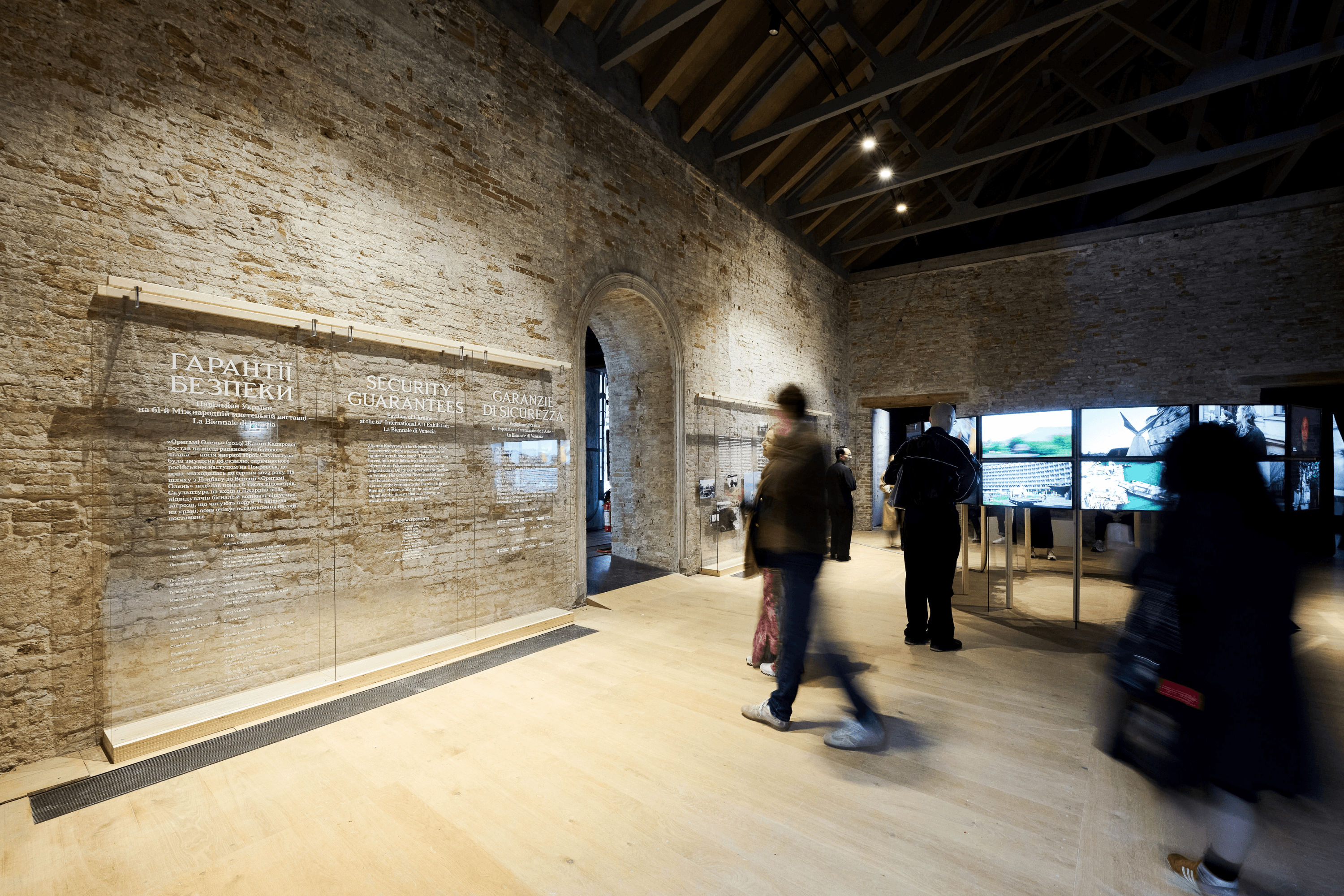
Photo: Valentyna Rostovikova for Ukrainian Pavilion / YB
1
At the entrance to the Arsenale, one of the two main locations of the Venice Biennale, there is a massive queue. The sun is scorching, and the baking concrete offers no respite. On May 6, there was rain and strong wind in Venice, but by the 7th, it was already summer weather. “I wonder how much longer we have to wait,” a voice complains in Russian, the accent unmistakable. Russians are the main talking point this year. Ironically, my own Biennale experience begins exactly with them.
Russians are also the first to ask questions at the press conference in the Ukrainian pavilion—about Russians, of course. Next, Ukrainian journalist Yana Suporovska addresses Zhanna Kadyrova. She asks how the artist feels about constantly being asked such questions. While people around nod their heads in approval (including the journalist who asked the first question), Zhanna replies: “I am a Ukrainian artist. Of course, I want to speak about Ukraine.”
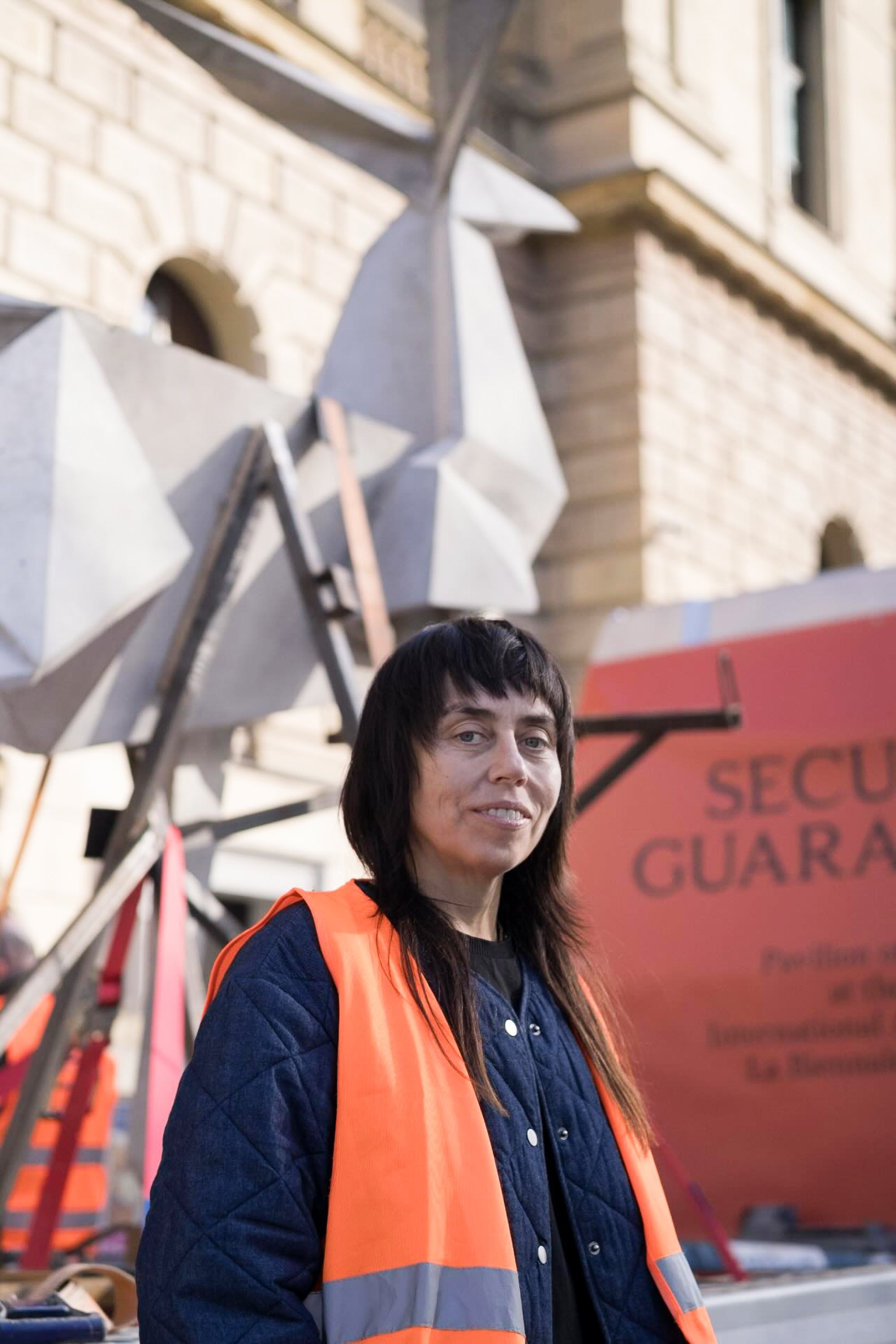
Zhanna is no stranger to the Biennale, but today she is clearly anxious. Perhaps it’s because this is her first solo project within the framework of this exhibition. Perhaps it is because too much attention is being paid to Russia. Or perhaps it is because this deer sculpture and its evacuation from Pokrovsk is a very personal story.
“When I saw this deer [in Pokrovsk], a cold sweat broke over me. I thought we had forgotten about it,” says Leonid Marushchak, one of the exhibition’s curators. He is dressed in simple black trousers and a T-shirt, occasionally wiping sweat from his forehead—it is stuffy inside the Ukrainian pavilion. “I went to Zhanka and said, 'Do you know [that the sculpture is still in Pokrovsk]? ' She replied, 'I know, but what can I do? ' We searched for a long time for a way to take it out. We reached out to the Pokrovsk Museum; they agreed to the evacuation, but that was all. Eventually, the Pokrovsk city administration helped, and in August, we transported the deer to my native Vinnytsia. It was there we decided that this story needed to be told to the world.”
Leonid is constantly distracted—he is giving comments in every direction, which his wife, Marta, gently reminds him of from time to time. Marushchak speaks to foreign journalists in Ukrainian, and Marta translates for him. It’s impossible to imagine Leonid at such an important event without his wife. They are a team and always act as a pair: whether it is evacuating museum heritage from the front lines or participating in one of the most prestigious exhibitions in the world.
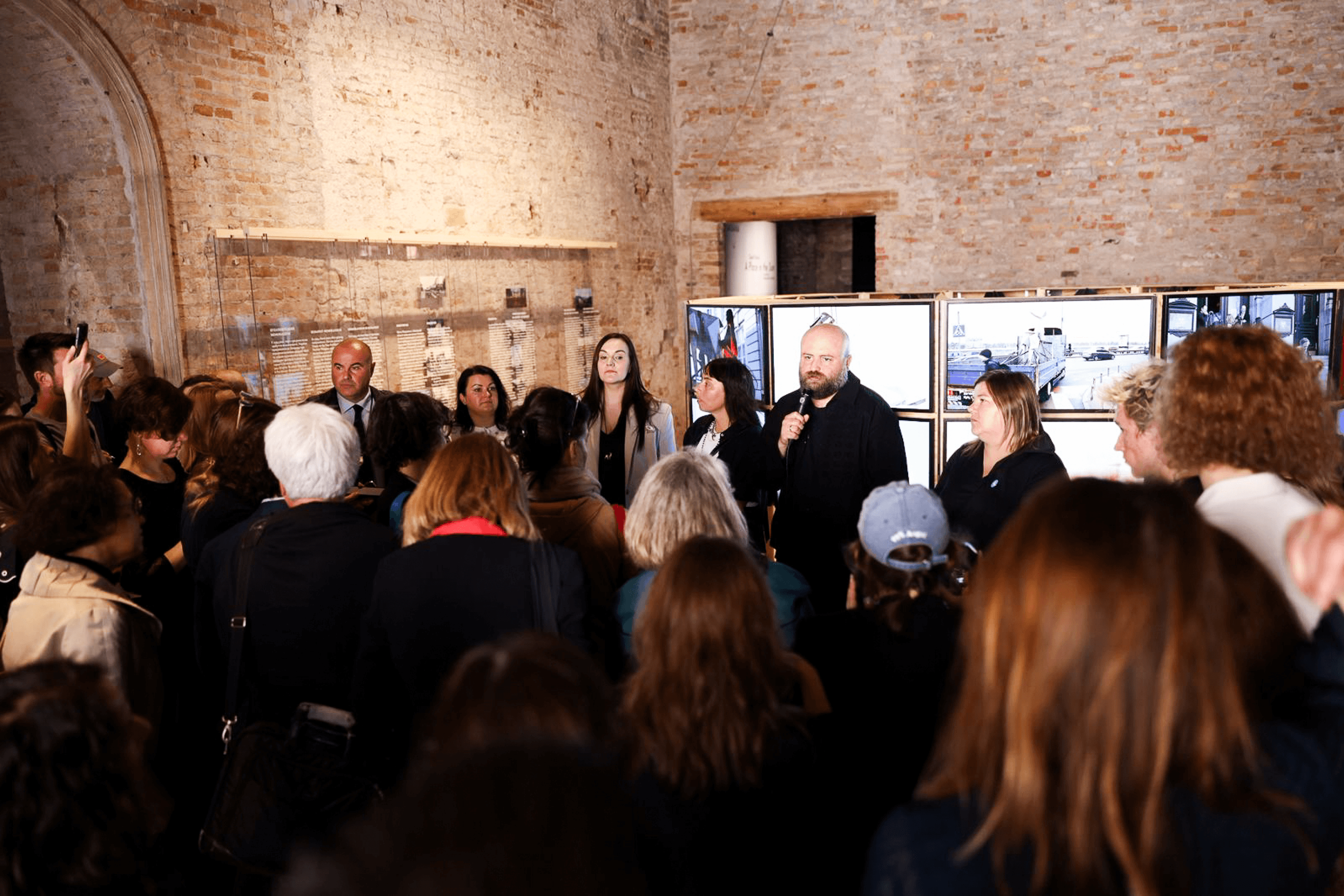
The Ukrainian “pavilion” is far from a prime location. In fact, it isn’t a pavilion at all—Ukraine doesn’t have own building like Austria, Canada or Russia. Currently, it is a transitional space, a thoroughfare leading to other similar “pavilions.” Space is limited, so the press conference is conducted in a hurried manner: brief speeches are given by the commissioner of the Ukrainian pavilion, Ukraine’s Minister of Culture Tetiana Berezhna, Kadyrova, Marushchak, and the exhibition’s other curator, Ksenia Malykh.
Marta asks everyone to honor the Ukrainians killed in the war with a minute of silence. Then she shouts “Slava Ukraini!” and the attendees respond “Heroyam Slava!” Amid the familiar Ukrainian voices, a slight foreign accent can be heard. “That’s how we re-educate them,” whispers a woman standing nearby. In the next room, loud music blares.
Kadyrova takes the floor to a thunderous ovation. She explains that the deer’s long journey to Venice was a performance in itself; in every city they passed, Pokrovsk natives came to greet the sculpture. Some are here today. The audience turns to two women holding Ukrainian flags, offering respectful applause. Later, the crowd lingers to take photos with them.
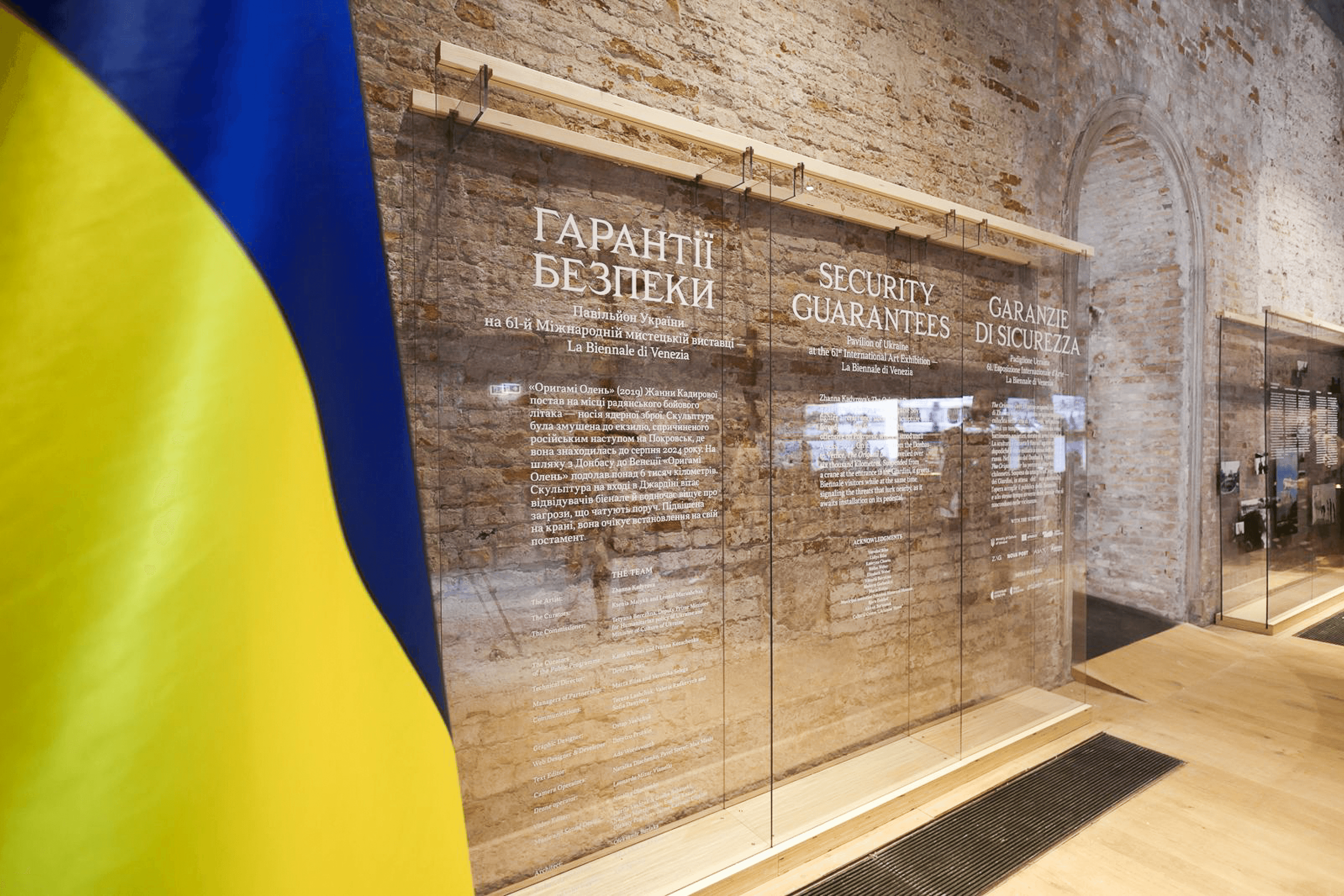
Interior details of the Ukrainian Pavilion “Security Guarantees” at the 61st Venice Biennale. Photo: Anton Tkachenko / Ministry of Culture / YB 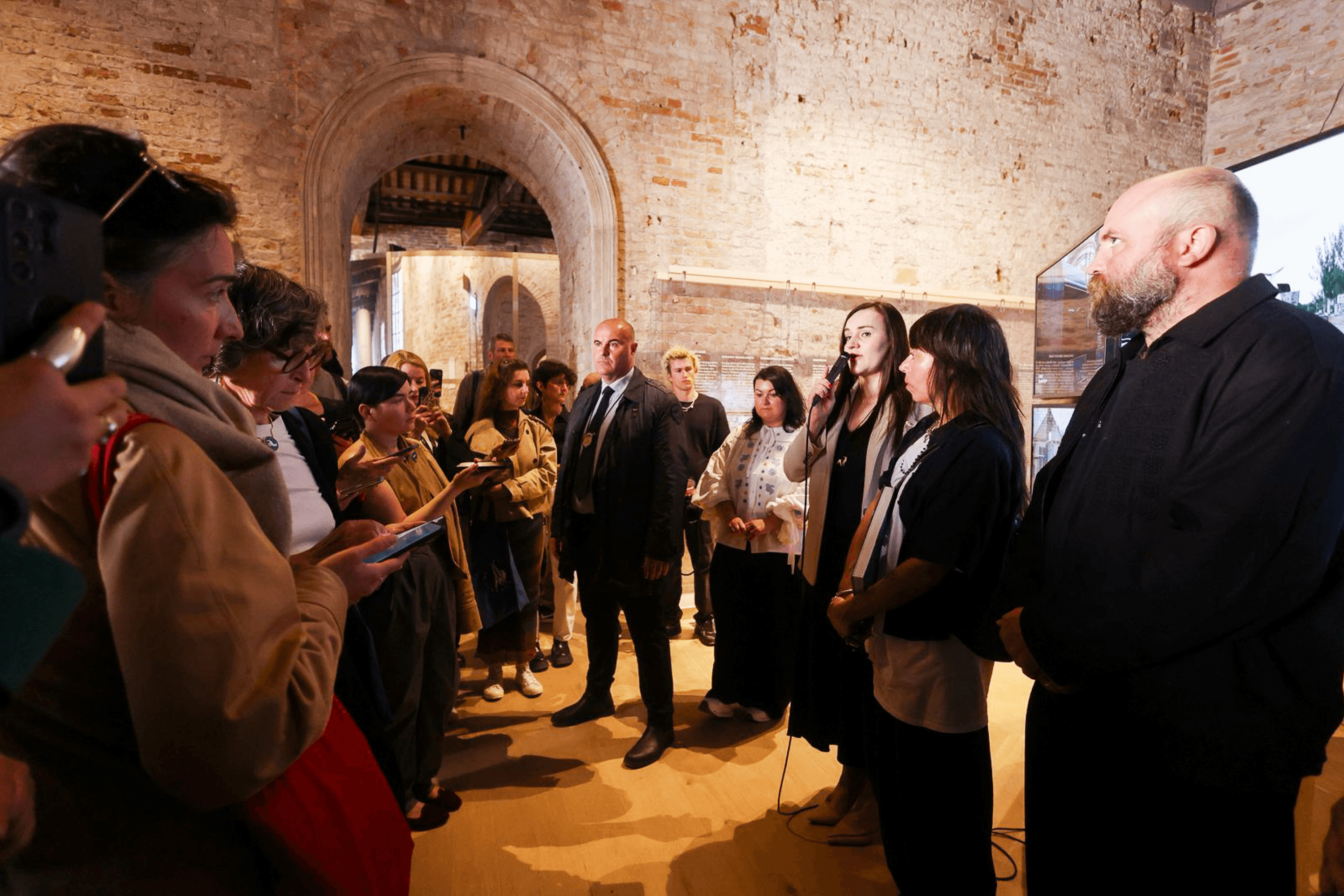
Photo: Anton Tkachenko / Ministry of Culture / YB 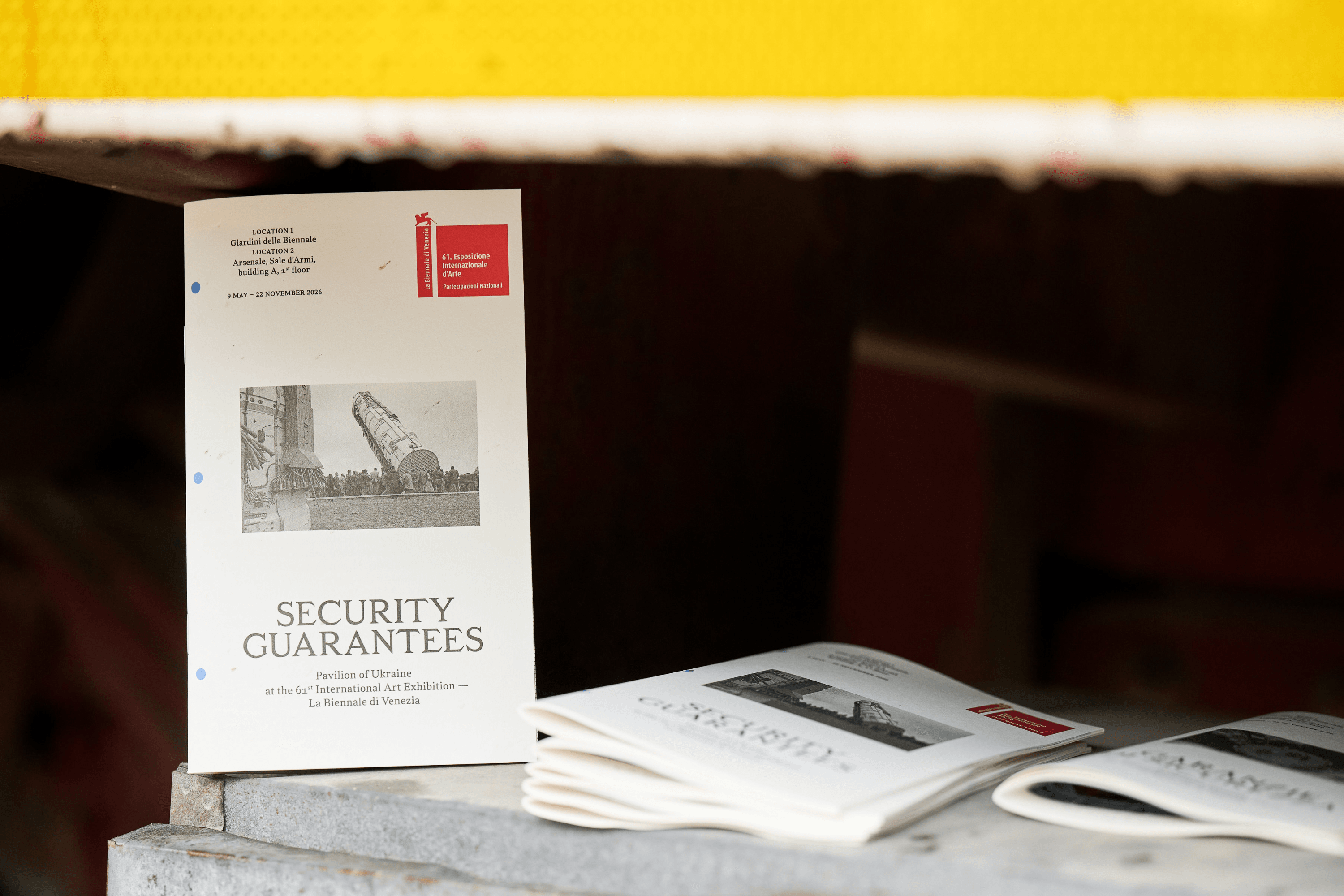
Photo: Valentyna Rostovikova for Ukrainian Pavilion / YB 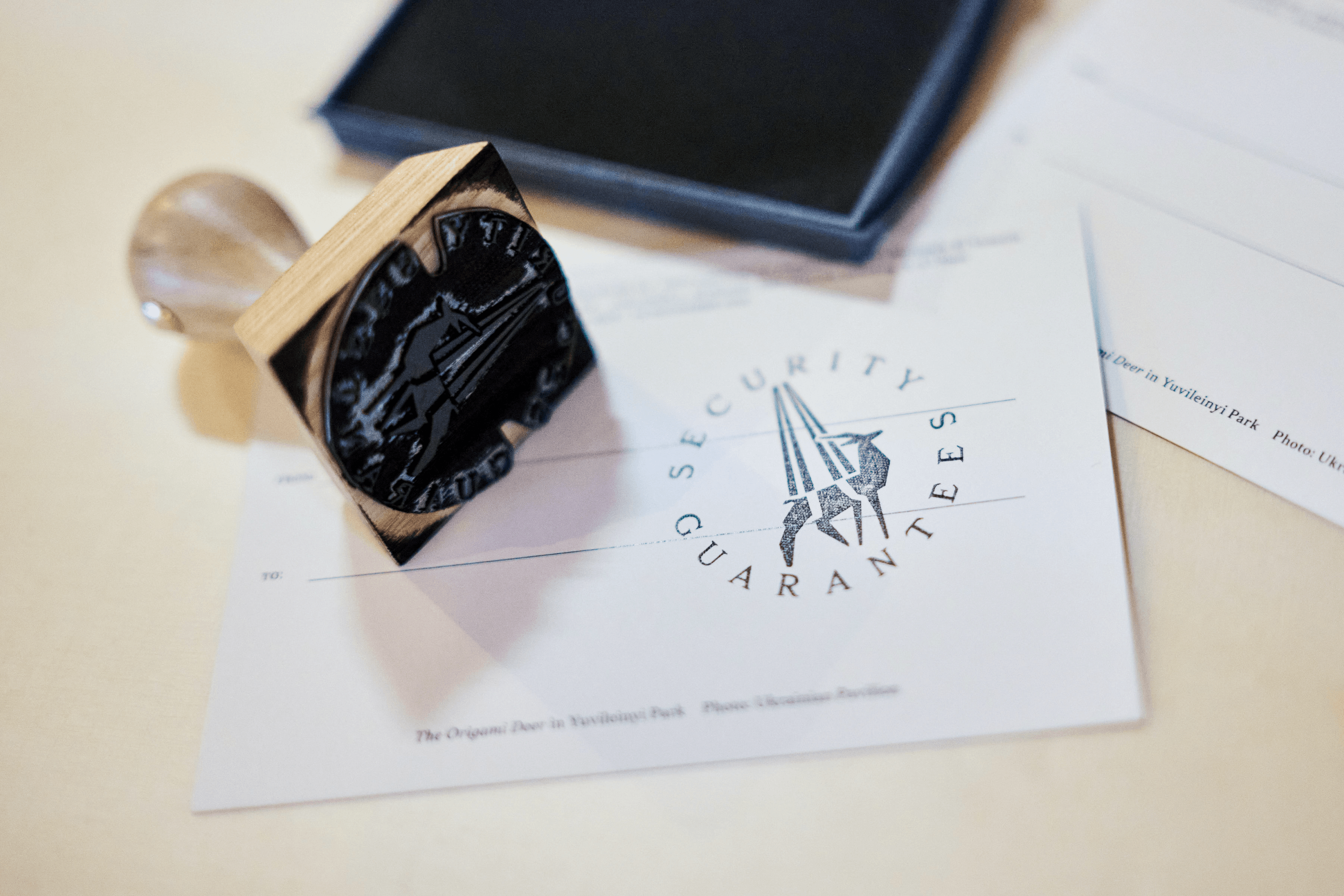
Photo: Valentyna Rostovikova for Ukrainian Pavilion / YB
2
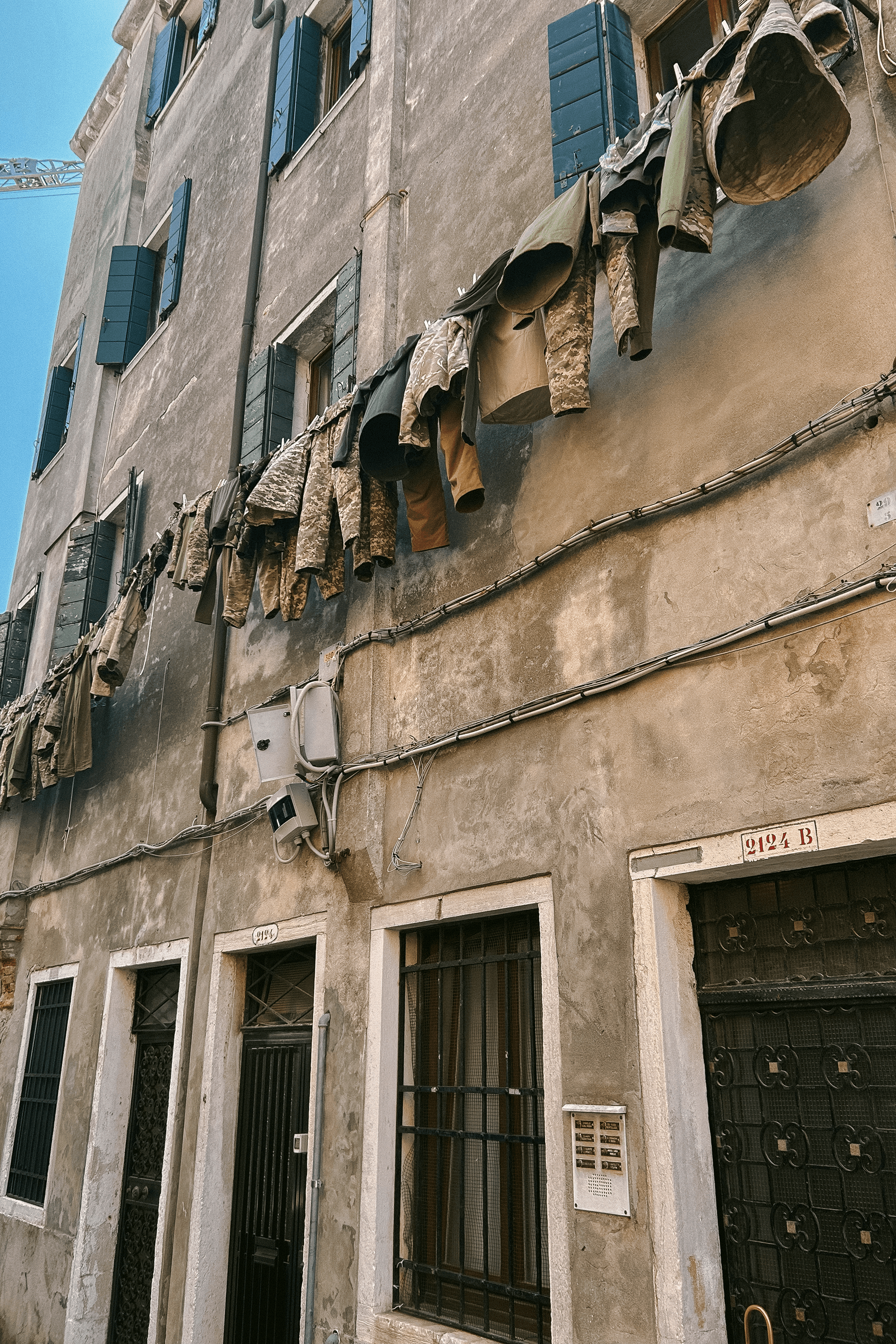
It is a leisurely thirty-minute stroll from the Arsenale to the Giardini—the Biennale’s sprawling second venue—past shimmering canals and centuries-old facades. But we are in a hurry, so there is no time to gaze at the beauty of Venice. Still, we notice how a Ukrainian pixel pattern hangs on seemingly ordinary clotheslines where laundry is usually dried. This is an installation by the artist Daria Koltsova, which she fundamentally decided not to sign. The uniform is real. “I wanted to remind people that the war exists, even if it’s invisible here,” Koltsova explained in a comment to Suspilne.
Another significant project is the “Invisible Battalion.” Posters designed to look like event playbills featuring Ukrainian cultural figures have been put up around Venice. Each one bears a glaring inscription: “Cancelled! The author was killed by Russia.”
“Oh, you’re going to be fucking blown away,” someone from the Ukrainian team says enthusiastically as we approach the Giardini.
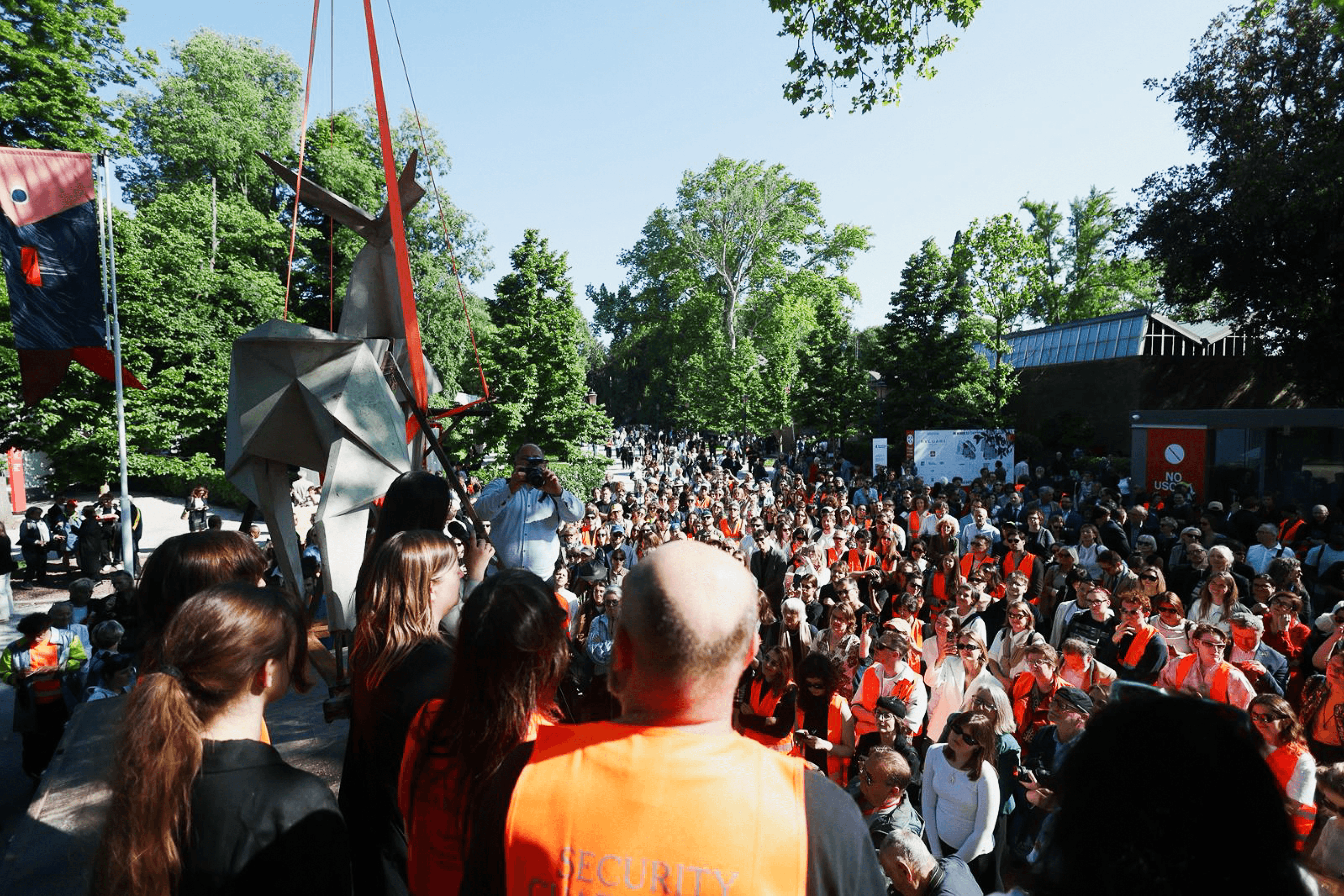
The deer stands right at the entrance. It is the first thing everyone sees when entering the main location, and the Ukrainian delegation is rightfully proud of this. Delivering a multi-ton sculpture on a crane-mounted truck to a city without cars is a Herculean task. Securing a spot for it when Ukraine has no permanent pavilion was even harder, requiring months of grueling negotiations. Now, the deer stands—or rather, hangs—suspended in mid-air.
The idea of the Ukrainian pavilion is simple. Once, in a park in Pokrovsk (which was called Krasnoarmiysk until 2016), there stood an actual metal aircraft capable of carrying nuclear weapons. Such monuments were mass-produced and installed across the entire Soviet Union in the 1970s. In 1991, the Union collapsed, and in 2005, it was the plane’s turn—it had rotted away. It was quickly taken down, but an empty pedestal remained in the park for a long time because removing it was too expensive.
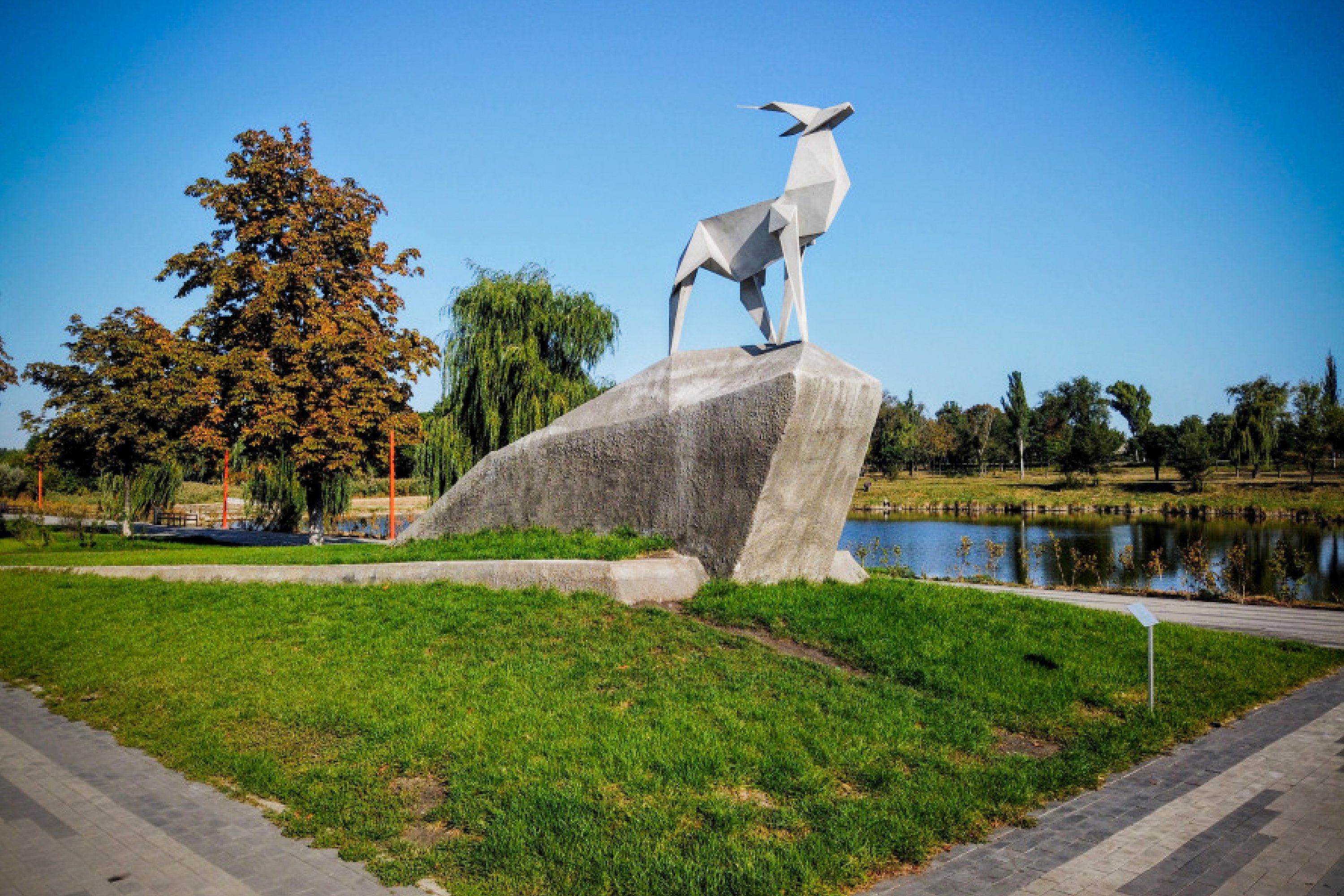
In 2019, the Pokrovsk city authorities turned to Zhanna Kadyrova with the idea of rethinking the concept of the monument. This led to the creation of the origami-style deer. The deer is a symbol of peace; origami represents openness, as anyone can fold it. Together, it tells the story of how Ukraine gave up its nuclear weapons for the sake of peace, only to end up with war.
“Tell everyone I’m only taking meetings right here!” says Ksenia Malykh, one of the curators of the Ukrainian pavilion, speaking off to the side as she sits tiredly on the asphalt behind the truck.
The official opening is scheduled for a few hours from now, but the entire delegation has been giving comments non-stop. Ksenia lights a cigarette and speaks to me.
“That’s the whole idea. The fact that the deer is suspended—just like all of us.”
Zhanna Kadyrova’s deer sculpture is installed near the Ukrainian Pavilion at the Venice Biennale. Photo: Valentyna Rostovikova for Ukrainian Pavilion / YB 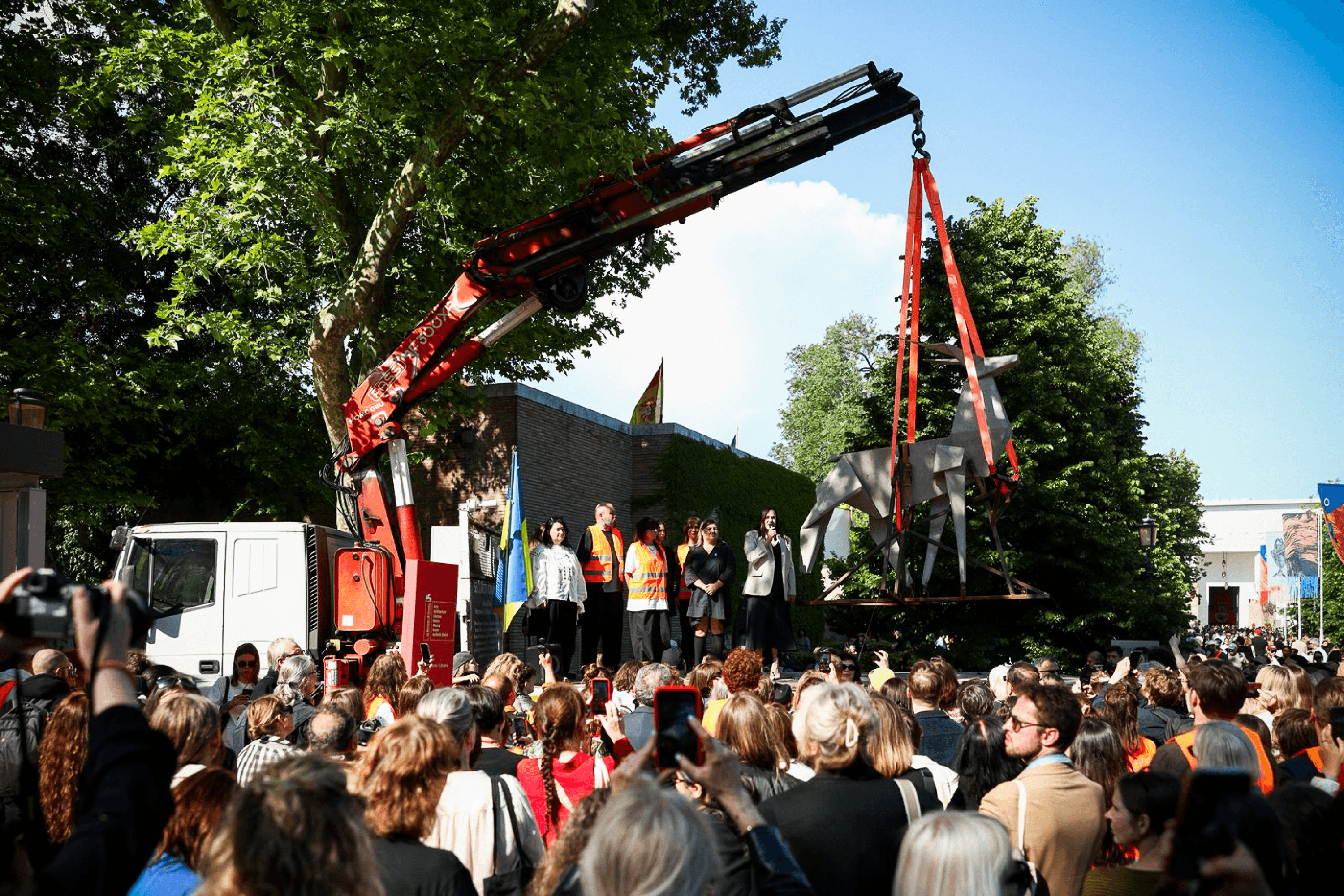
Photo: Anton Tkachenko / Ministry of Culture / YB 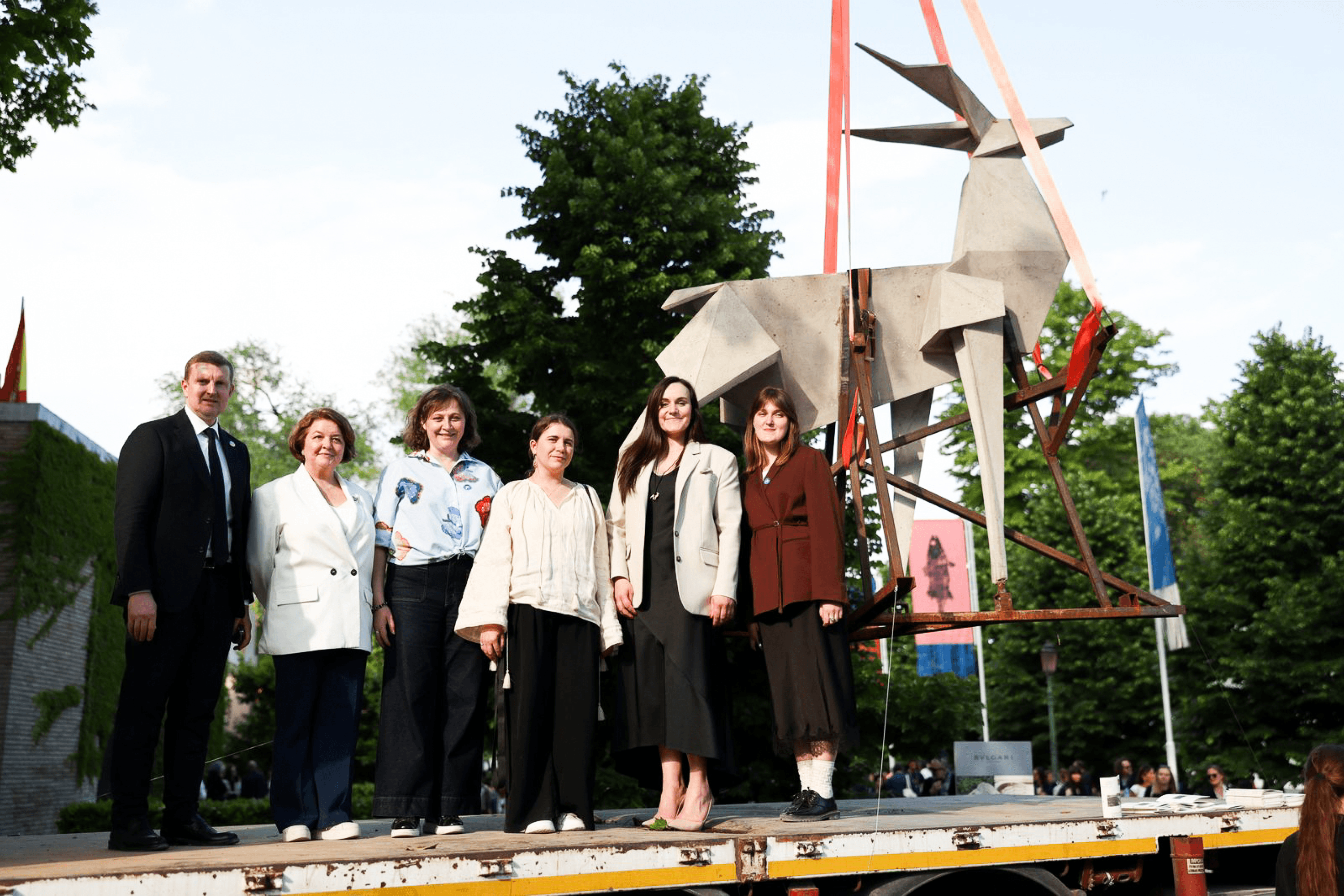
Photo: Anton Tkachenko / Ministry of Culture / YB
“Do foreigners pick up on that?” I ask.
“Yes. You know, human stories work very well. When we tell them how people [from Pokrovsk] in every country greet the deer like a fellow countryman, it hits home. It really hits home.”
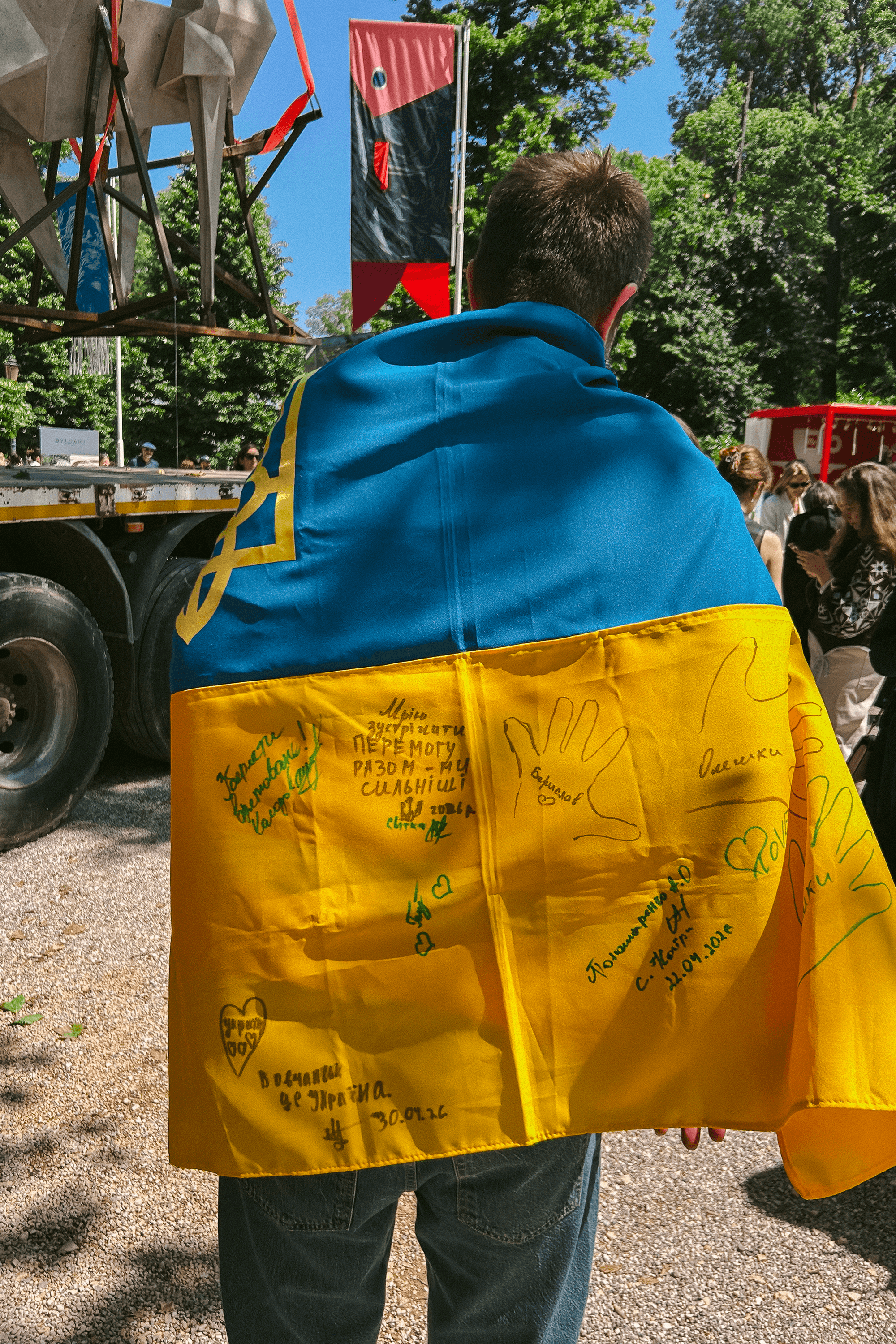
Dozens of people are gathered around the deer. Serhiy Kukhtin, head of the “Foundation for the Future,” stands with a Ukrainian flag draped over his shoulders, covered in signatures. They were left by Ukrainian teenagers whom Serhiy’s organization brought back to Ukraine from occupation and Russian territory.
Tetiana Berezhna rocks a stroller with one hand; her six-month-old daughter, Osaka, often accompanies her mother on trips. After the Biennale, in a conversation with Yellow Blue, Berezhna will say half-jokingly that Osaka helps her build diplomatic bridges (look for the interview on our website soon).
Zhanna Kadyrova, wearing a bright orange vest similar to the high-visibility gear worn by municipal workers, is giving what must be her twentieth interview of the day. This vest was the Ukrainian team’s idea; on the back, it reads “Security Guarantees.” They are handed out to anyone who wants one, and almost the entire Ukrainian team is wearing them. The vivid orange stands out sharply against the greenery of the Giardini gardens and draws even more attention to the exhibition.
“Do you know when they are going to lower it [the deer]?” an unfamiliar journalist who just arrived asks me in English. She gestures toward the sculpture, which is held up by a crane, and frankly, it looks precarious. But that was exactly the intention.
“No, it will stay like that,” I reply.
“Oh! That’s so symbolic.”
3
On May 9, the Biennale opened to the general public. At ten o’clock that morning, a rally against Russia’s participation was scheduled to take place in St. Mark’s Square in Venice, not far from the Arsenale.
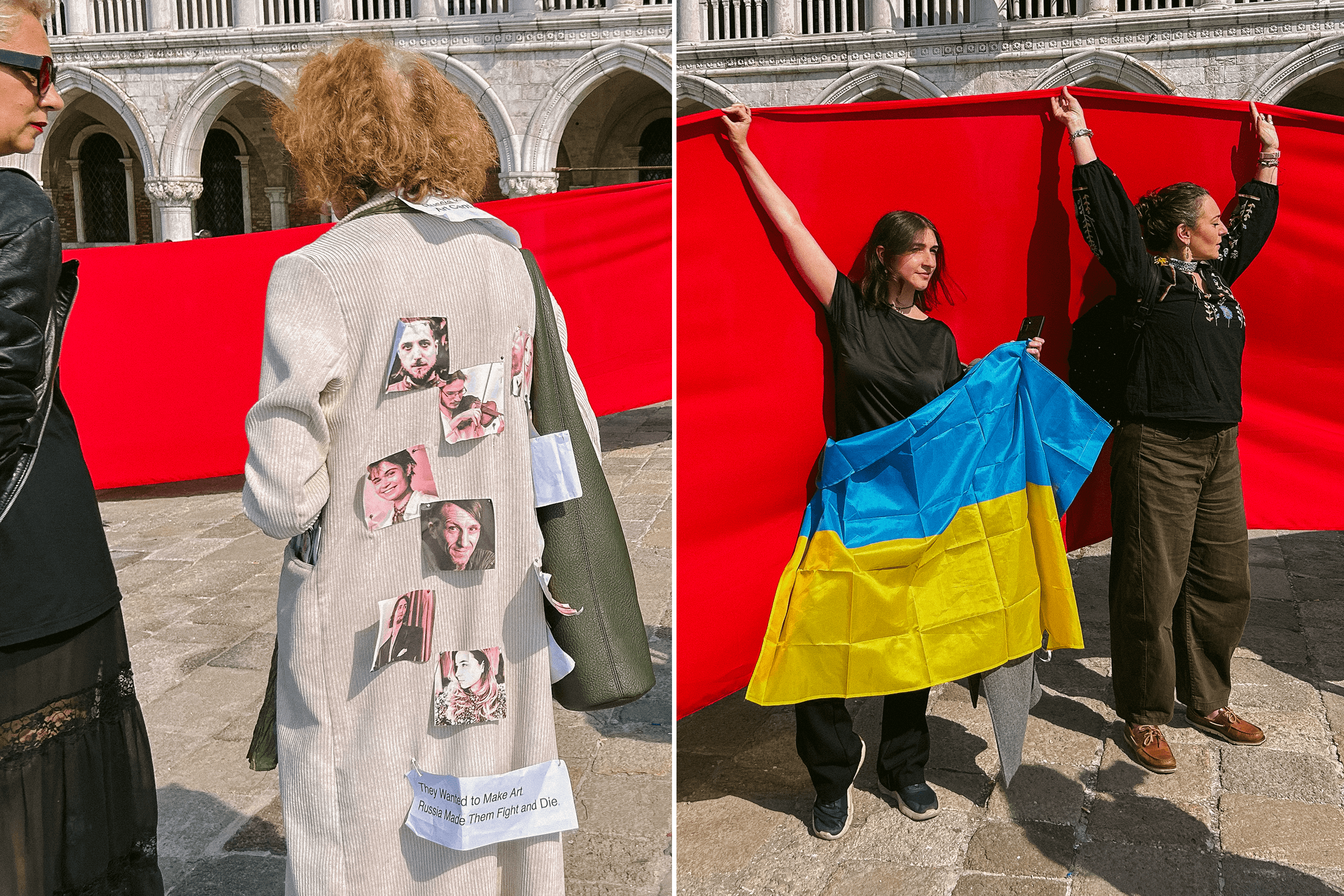
The first to arrive are about ten girls carrying a large red banner. Each is wearing a black T-shirt with various inscriptions: “Bucha, Mariupol, Venice?”, “Russian Pavilion Founded by War”; “No War Criminals”. The girls stand in silence. The T-shirts speak for themselves.
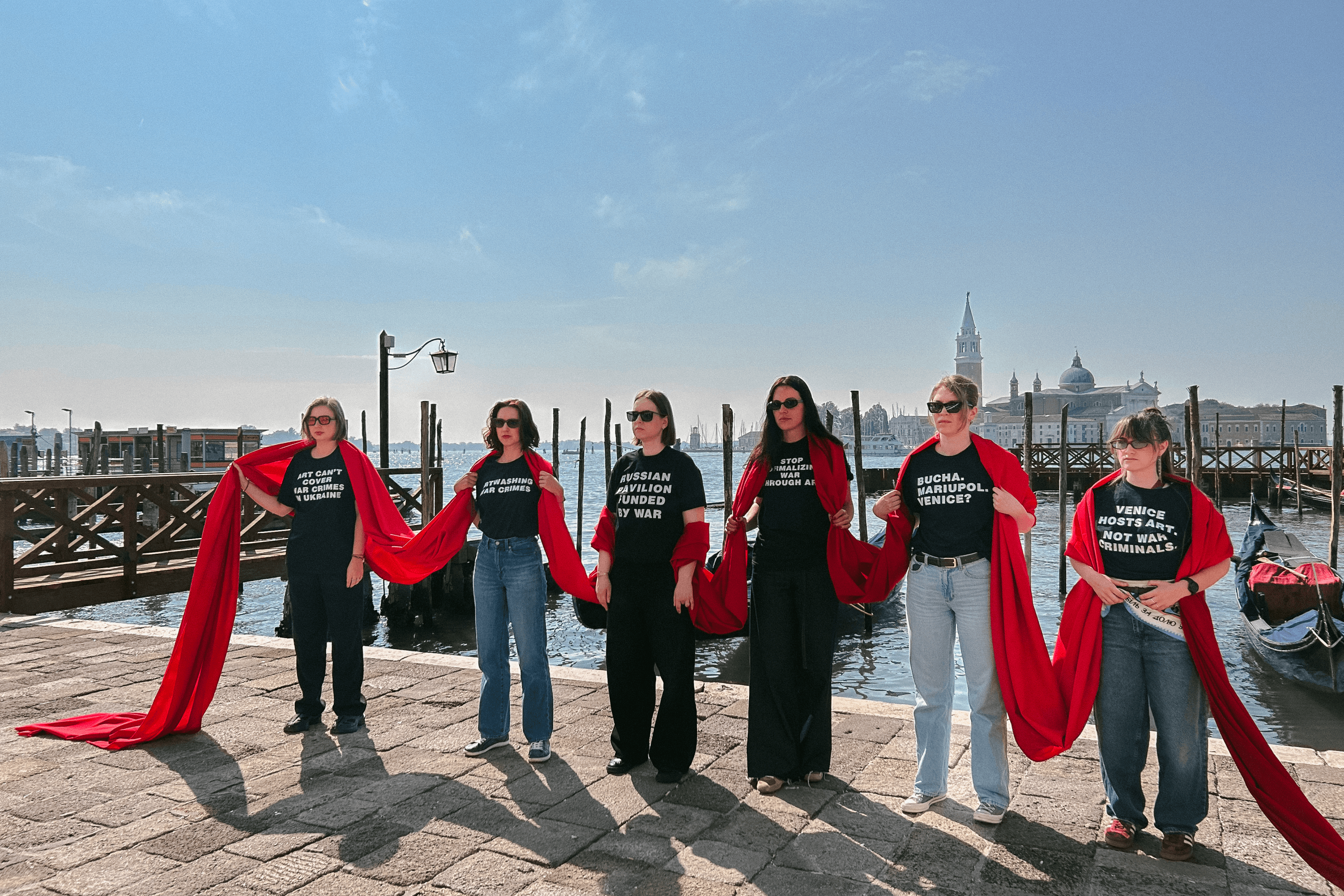
“We came specifically [from Ukraine] to voice our protest,” says one of the girls. Her name is Kateryna Levchenko, and she traveled from Kryvyi Rih. “Perhaps my visit to the Biennale is the last thing I will do in my life. And I want this to be heard.”
The protesters place two large flags on the pavement—those of Ukraine and the European Union. On top of them sit museum display cases containing fragments of Russian shells—an illustration of how Russia is destroying Ukrainian culture. On a black poster nearby, the words “Russia is a Terrorist State” are written in large red letters.
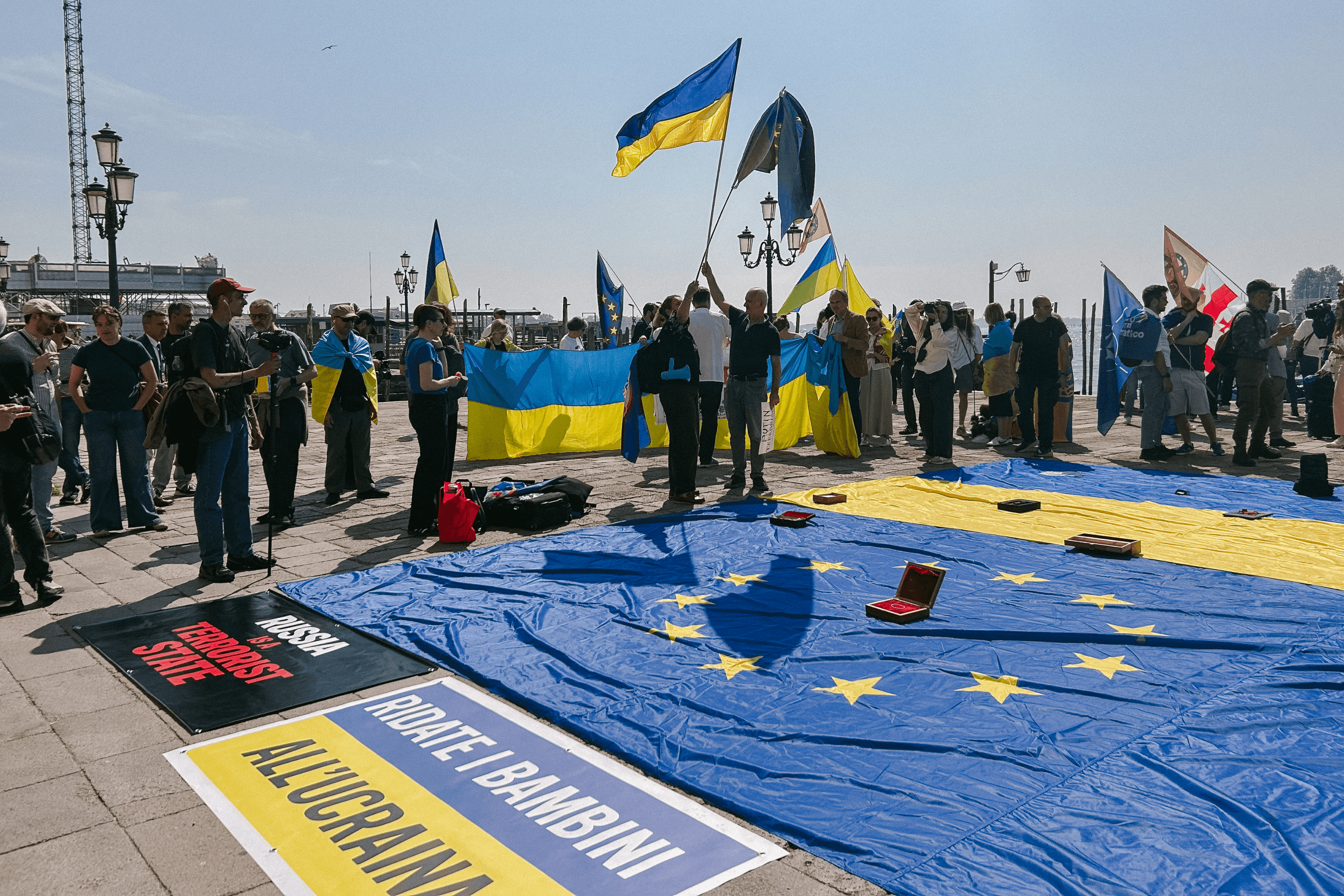
Participants of a rally in Venice unfurled the flags of Ukraine and the European Union in support of Ukraine. Photo: Yuliana Skibitska / YB 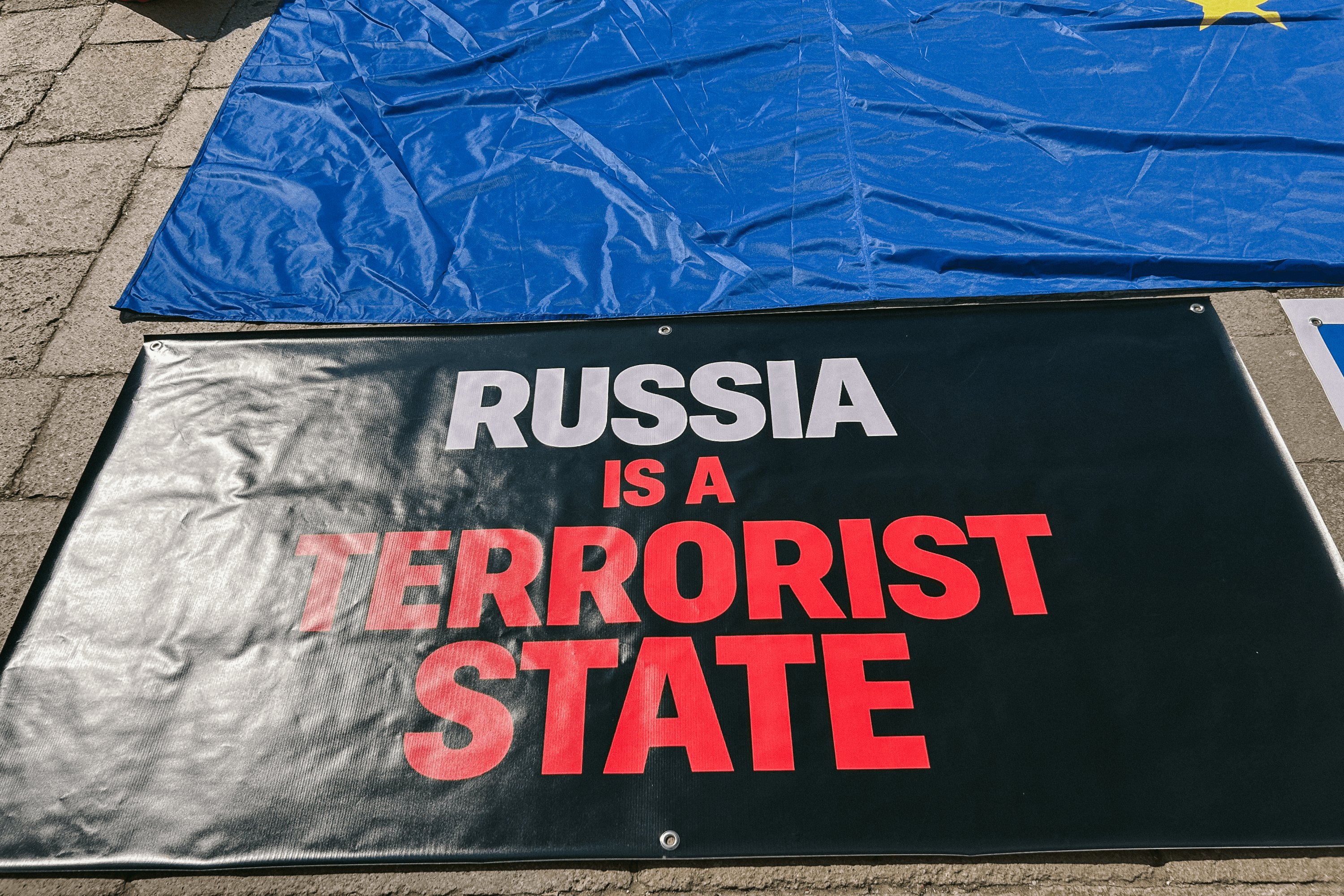
Photo: Yuliana Skibitska / YB 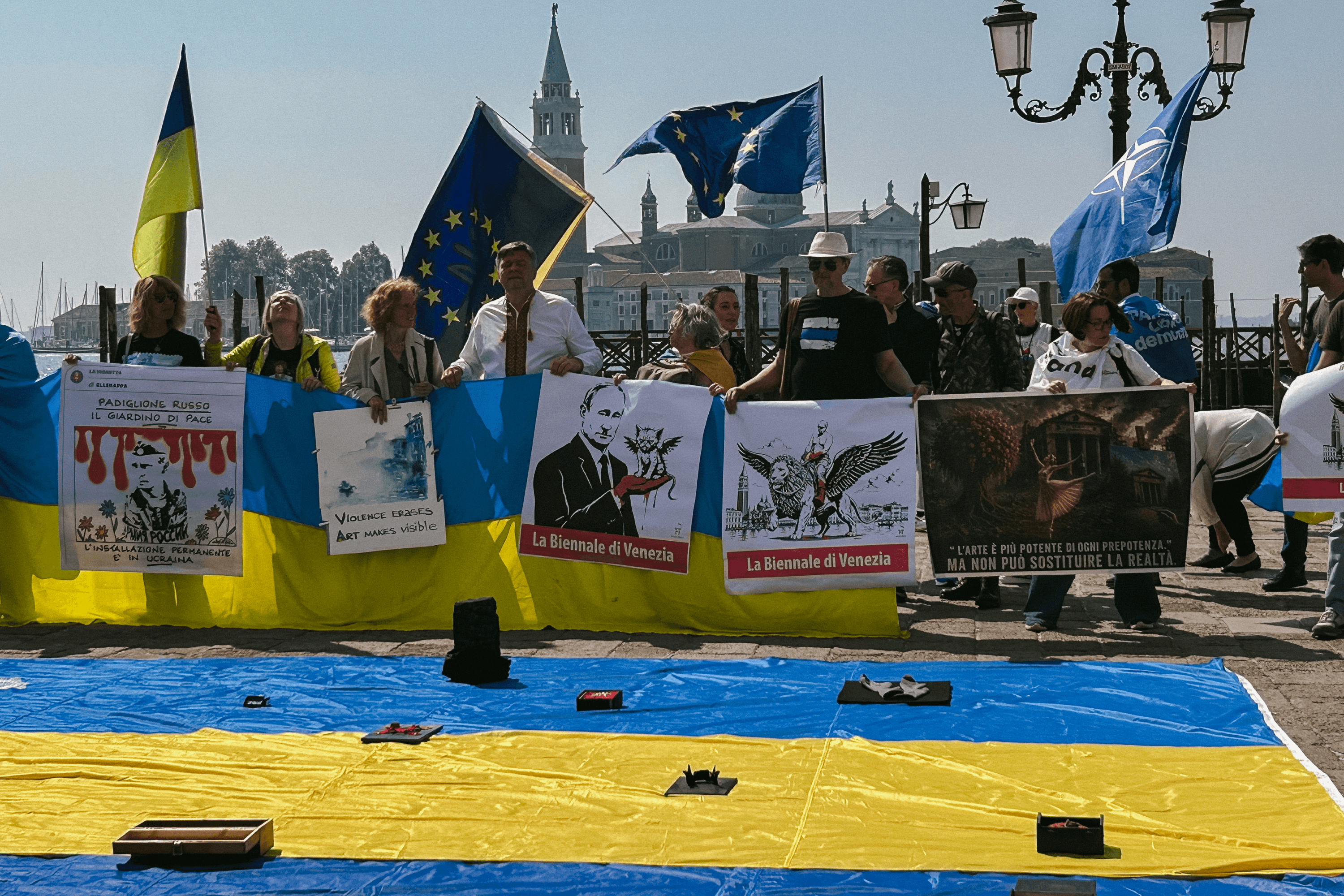
Photo: Yuliana Skibitska / YB 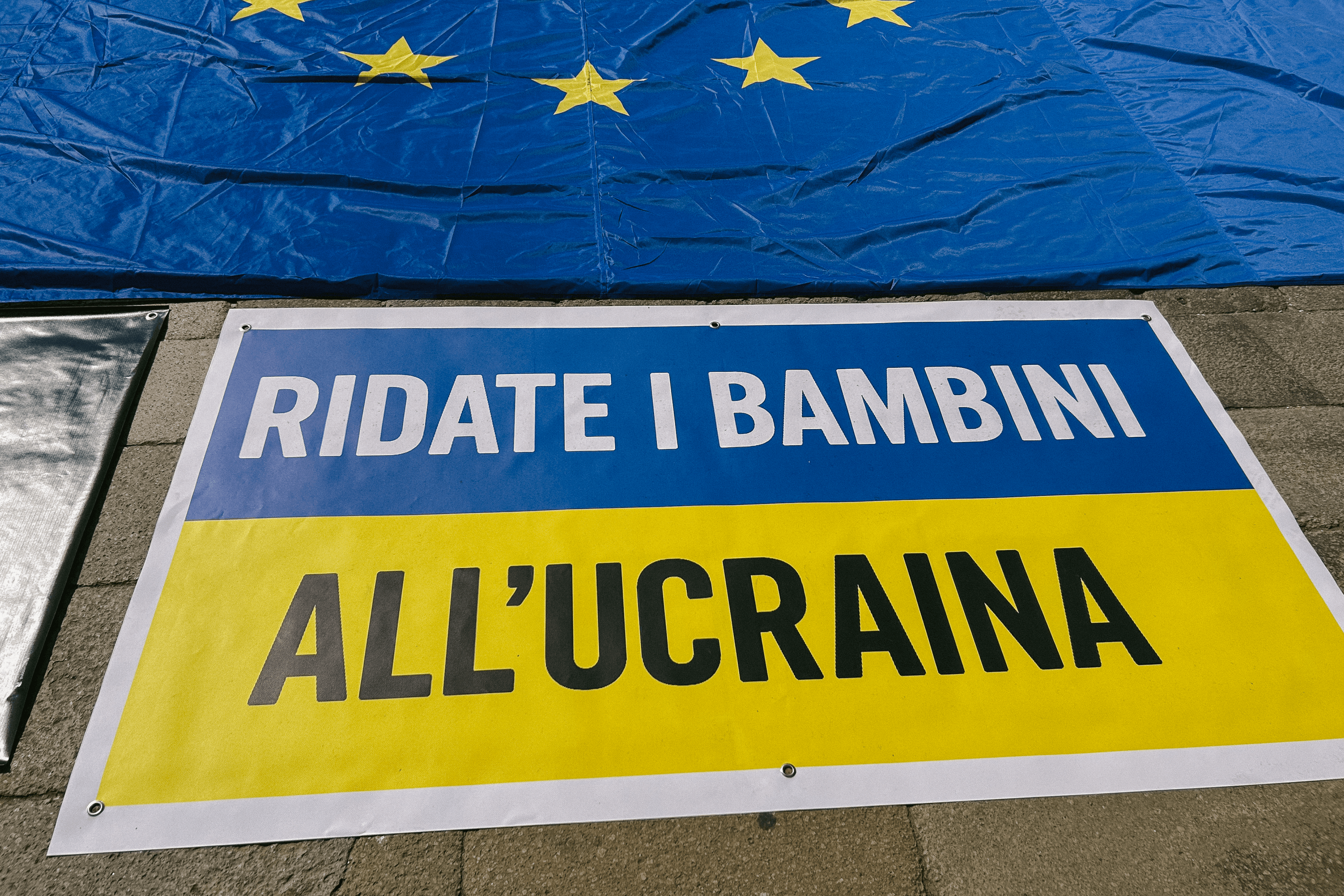
Photo: Yuliana Skibitska / YB
Many Ukrainians are present at the rally, mostly from the diaspora. A grey-haired Italian man in a cap holds a poster in the colors of the Ukrainian flag. In Italian and Russian, it speaks of Russia committing genocide against Ukraine.
“I’m Italian, but I am with Ukraine with all my soul,” he says in broken Ukrainian. “Gloria all’Ucraina!”
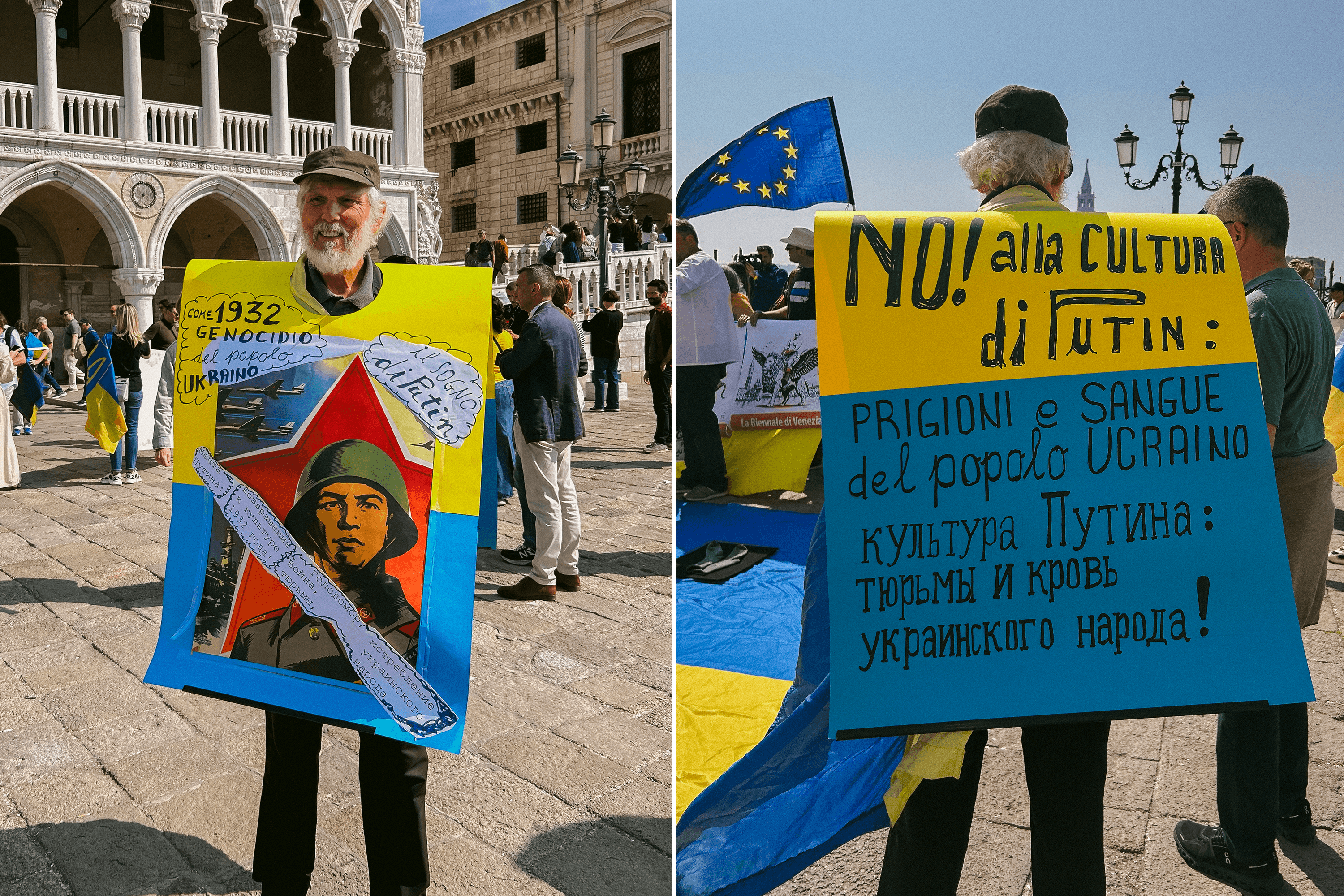
This part of Venice is always crowded. Some people photograph the posters, while others simply pass by. A tour group stops near the protest. “This is an action against Russia’s participation in this year’s Biennale,” the guide says, gesturing toward the flags and posters. “As you know, Russia kills Ukrainians every day.”
“Very good,” a woman says in Russian, stopping in front of a man holding a poster that depicts Vladimir Putin riding a golden lion, the symbol of the Biennale. Because of Russia’s participation, the entire Biennale jury resigned, so the statuette will not be awarded to anyone this year. “It speaks very clearly about what is actually happening here,” a woman continues.
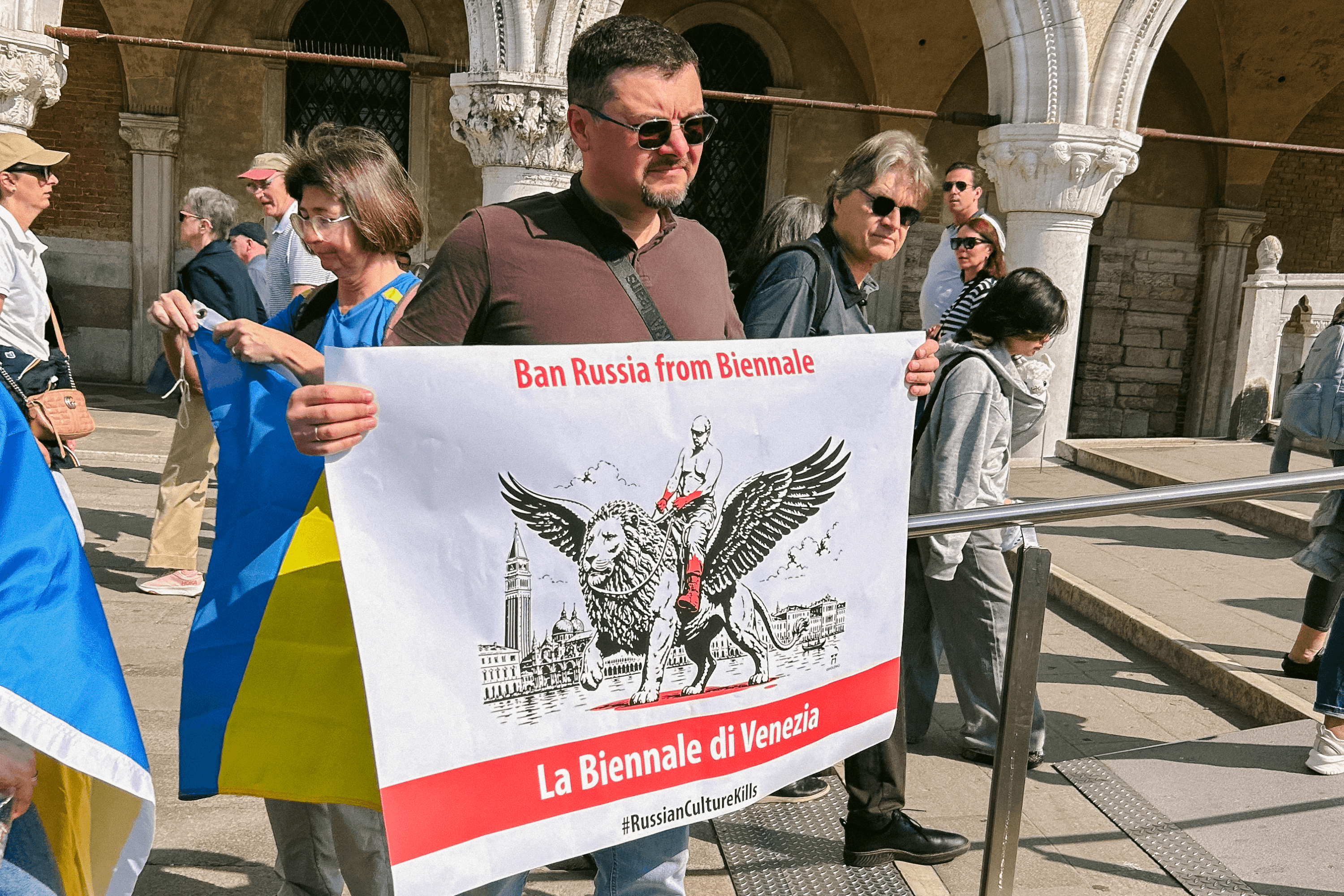
This protest is not the first one. Since May 6, when the Biennale opened for the press, such actions have taken place every day. Some were held near the Russian pavilion in the Giardini—these rallies were organized by the Russian feminist group Pussy Riot along with the Femen movement. At the same time, the pavilions of Lithuania, Latvia, and Estonia held an action in support of Ukraine at the Arsenale. And on May 8, the largest rally took place—not about Ukraine, but about Palestine. Various activists—from artists to Italian communists—protested against Israel’s participation in the Biennale.
“We weren’t asked these questions [about Israel’s participation],” says Ksenia Malykh. “But the only thing that can be said is: these overlapping protests against Russia, Israel, and the U.S. don’t truly serve any of the victims.”
Participants in a rally in support of Ukraine in Venice. Photo: Yuliana Skibitska / YB 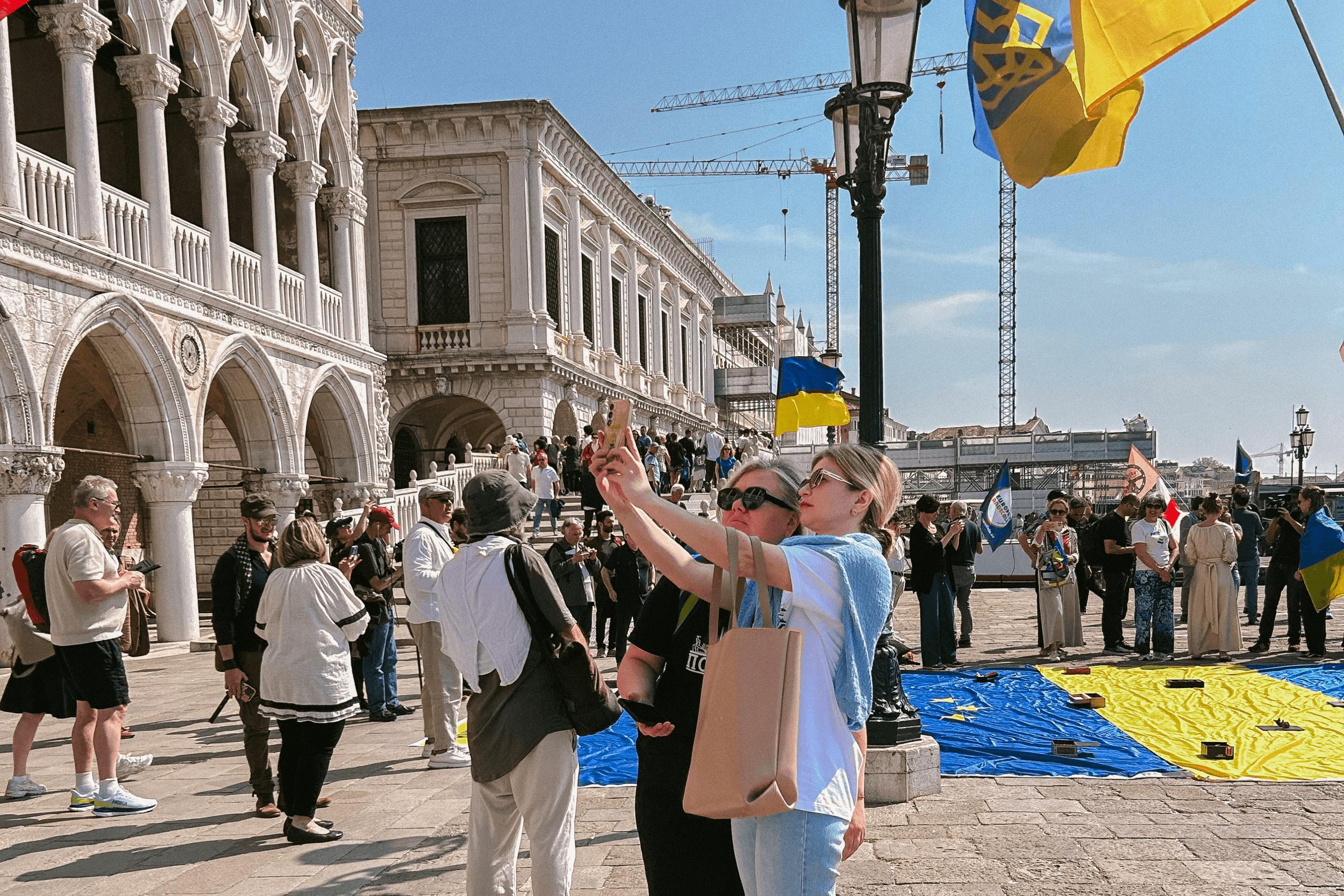
Photo: Yuliana Skibitska / YB 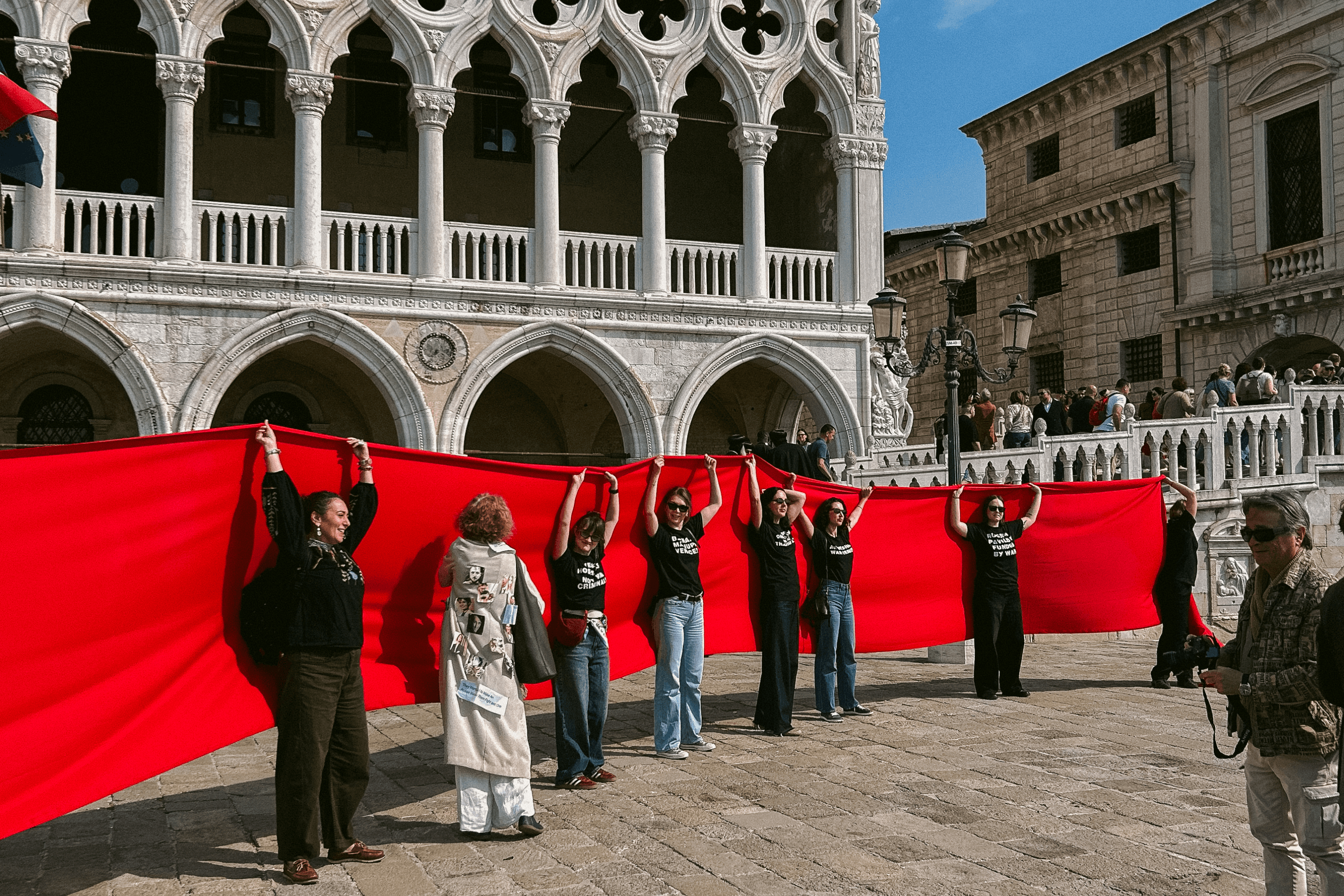
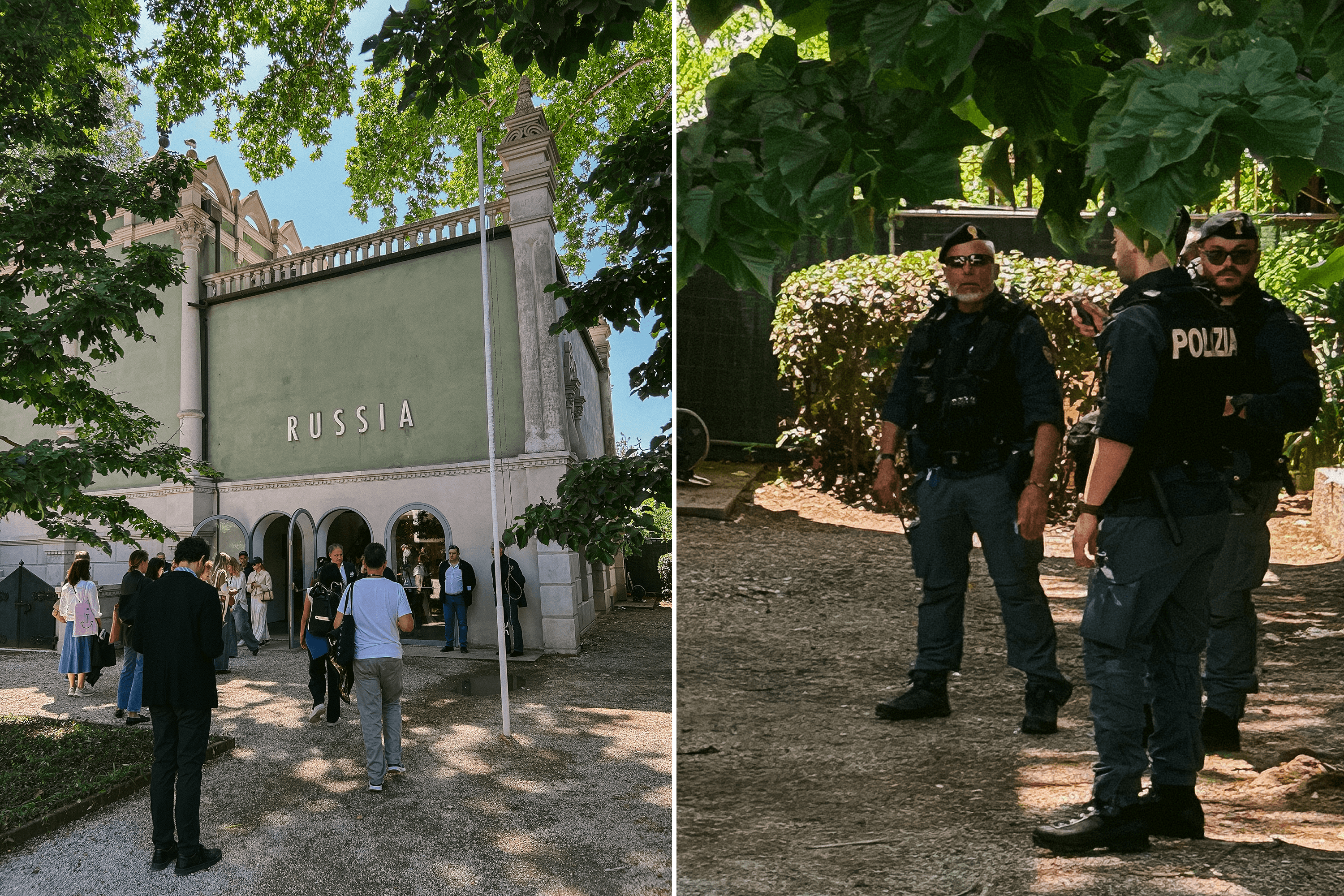
Photo: Yuliana Skibitska / YB
4
On May 9, the “Invisible Battalion” posters were already hard to find on the streets of Venice—torn away or buried under fresh layers of advertisements. The military clothing hung by artist Daria Koltsova had been removed. The Russian pavilion had fallen silent. After days of staged performances and free-flowing alcohol, the building was now shuttered, guarded only by dozens of police officers.
“Russia actually gave us a very good boost,” Ksenia Malykh admits. “Although our project would have been talked about anyway because it is very timely and simple. But, of course, Russia’s return intensified the attention on us. And we are trying to use all this attention to tell our story to the world. Russia dumped a lot of money in to try and return to the global stage again. But look, no one is discussing their art. Everyone is only talking about the fact that they returned.”
Ksenia takes a tired drag of her cigarette and continues:
“You can tell what concerns a country by its pavilion. That is why, for example, the Swiss pavilion is speaking about the problems of the queer community for the second time. And that’s cool, but you realize that when a country speaks about that, it means everything is fine there. The Biennale is a sort of vanity fair where countries measure their budgets and agendas against each other. In the Austrian pavilion, female performers will be working for half a year. And against this backdrop, we simply cannot compete at full strength.”
The deer continues to stand in its place. Its head is held high—it symbolizes, as Ukraine’s Minister of Culture Tetiana Berezhna says, all Ukrainians who likewise stand with their heads held high. I ask Ksenia Malykh what will happen to the deer after the Biennale ends. Will it be returned to Ukraine?
“We would like to,” she smiles. “But it has to stand here for another half a year. We Ukrainians don’t plan anything that far in advance.”