Russian missiles and drones regularly target Ukrainian businesses, striking factories, warehouses, retail locations, and logistics hubs. Companies are losing critical inventory, equipment, and facilities, forcing many to rebuild from scratch or shut down completely.
Yellow Blue tracks businesses impacted by Russian attacks in one centralized list. Because strikes occur nearly every day, this directory is updated weekly. You can support these companies by purchasing their products in Ukraine and abroad—and help protect them from future attacks by donating to air defense.
|
Businesses affected in September
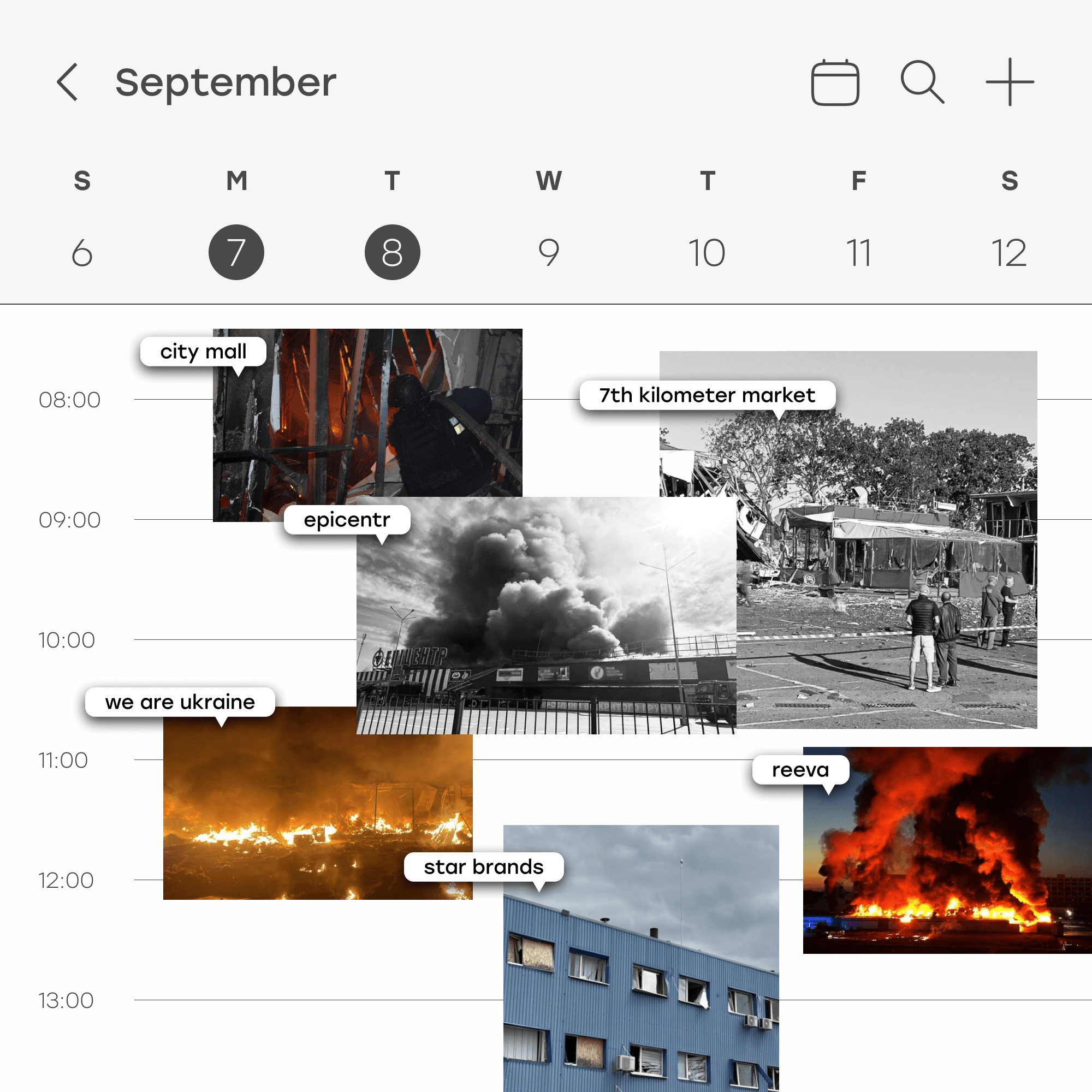
Overnight on September 8, Russia struck one of Eastern Europe’s largest markets, the 7th Kilometer market outside Odesa. Retail pavilions were heavily damaged, leaving the grounds covered in debris. A 58-year-old security guard was injured and hospitalized.
Later that afternoon, a Russian attack hit an Epicentr home improvement store in Pryluky, Chernihiv region. The company is currently assessing the extent of the damage. To date, Russian strikes have damaged 16 Epicentr stores and completely destroyed 13 others.
In Kyiv, a strike drone hit the offices of the We Are Ukraine TV channel during a live broadcast. At least five people were injured. The blast completely destroyed part of the building, blowing out windows and wrecking equipment rooms.
That evening, a Russian attack caused a massive fire that completely destroyed the Reeva instant noodle factory in Bila Tserkva. A distribution center belonging to the snack manufacturer Star Brands in the Dnipropetrovsk region was also damaged—marking the third time Russia has targeted this business.
Overnight on September 7, Russian forces struck the City Mall in Zaporizhzhia, one of the region’s largest shopping centers, causing severe structural damage and sparking a fire that covered nearly 700 m². Because all staff and visitors were evacuated during the air raid alarm, no casualties were reported. City Mall’s management plans to rebuild the facility as quickly as possible.
On September 5, Russia destroyed an Epicentr hypermarket in Mykolaiv. Firefighters and the supermarket’s staff had nearly extinguished the initial blaze when Russia launched a second wave of strikes, forcing rescuers to retreat. A sixth drone strike caused the building’s walls to collapse entirely.
On September 4, a blast wave damaged a location of the Zavertaylo bakery chain in central Kyiv. A customer seated near the window was injured. This is the third Zavertaylo location damaged by Russia during the full-scale invasion.
That evening, shelling destroyed a warehouse belonging to the Ukrainian branch of Santa Bremor, a seafood manufacturer. No casualties were reported.

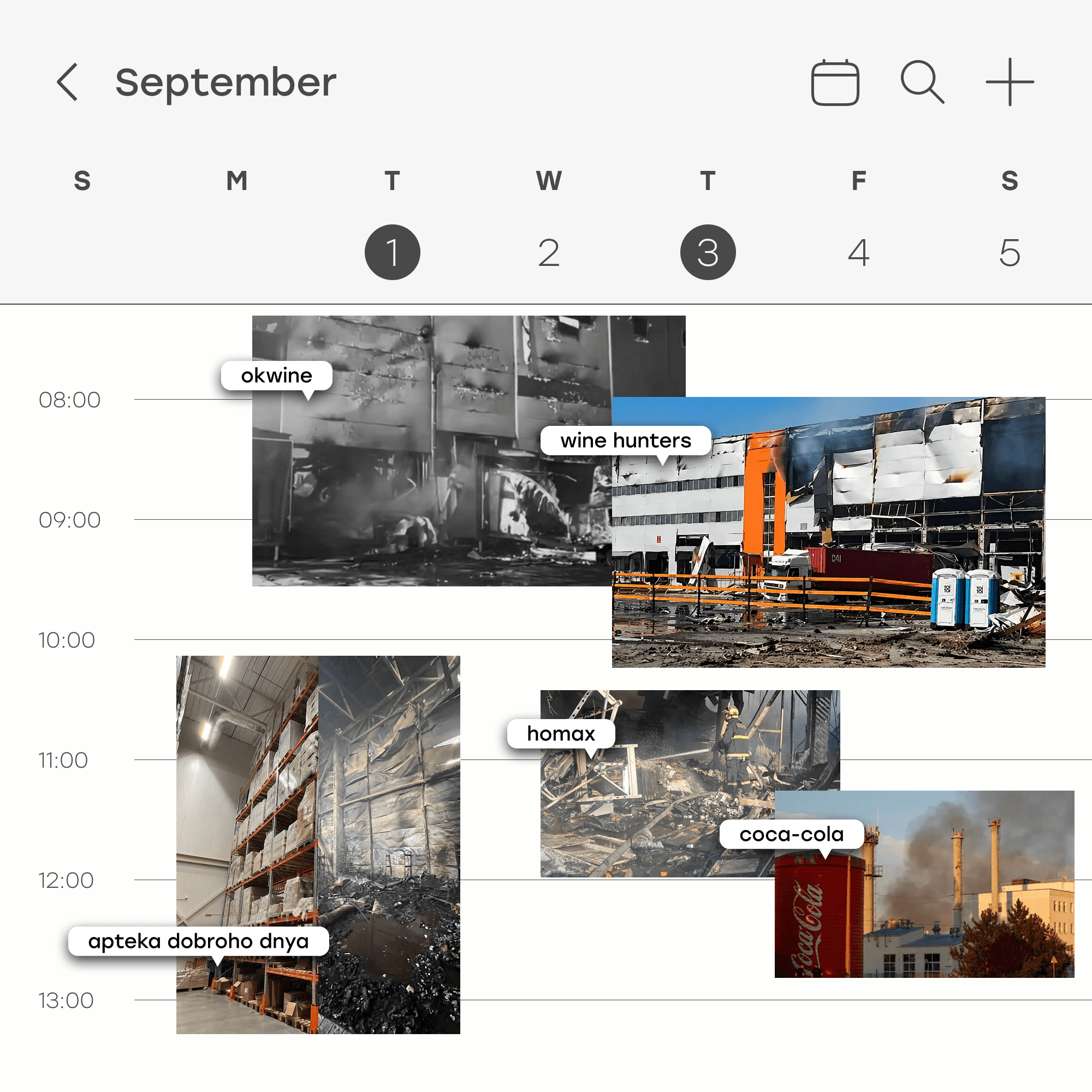
On September 3, Russian drones targeted the Coca-Cola bottling plant in the Kyiv region, damaging its storage facilities. The site is one of Coca-Cola’s largest production facilities in Europe. No staff members were injured.
During the same attack, Russia destroyed a central warehouse belonging to Apteka Dobroho Dnya, one of Ukraine’s largest pharmacy chains. The fire gutted the building and destroyed hundreds of tons of vital medical supplies.
On September 1, Russia destroyed the newly opened central warehouse shared by the Okwine liquor chain and distributor Wine Hunters. The companies had launched the facility following a July attack that destroyed their previous warehouse along with virtually all their inventory. No staff were injured; total losses from the destruction of both facilities exceed $13.4 million.
That same day, a fire destroyed a warehouse owned by Homax, an importer of home goods and accessories. The company’s remaining inventory is now limited to stock already delivered to retail partners. Homax is currently evaluating the extent of its losses.
Businesses affected in August
Throughout the day and night of August 31, Russia launched a massive attack on warehouses across the Kyiv region. Strikes hit the children’s retailer Budynok Ihrashok, confectionery maker Roshen, home goods chain Avrora, electronics distributor Comfy, vitamin importer Orthomol.Life, online tile and plumbing store Agromat, as well as supermarket chains Silpo, Fora, Varus, ATB, and Auchan. Companies lost extensive inventory and warned customers of delivery delays.
In Zaporizhzhia, Russian forces struck the Zaporizhstal steel plant for a second time. Five missiles hit the site of a previous attack from August 11, which had already forced the facility to halt operations entirely. No casualties were reported this time, as workers managed to reach shelters. The company is assessing the damage and financial losses.
In the Odesa region, shelling partially destroyed a terminal belonging to Nova Poshta, Ukraine’s largest express delivery operator, disabling a sorting line vital to the area. No injuries were reported.

On August 29, a Russian strike hit a PepsiCo production facility in the Mykolaiv region, triggering a massive fire. No casualties were reported.
On August 28, four missiles destroyed the Khortytsa distillery (part of Global Spirits group) in Zaporizhzhia. The facility burned for at least three hours and is beyond repair. Lost inventory is valued at a minimum of $6.7 million.
That same day, Russian strikes destroyed the Chysta Voda bottled water production facility and a Nova Poshta sorting depot near Kyiv. As firefighters worked to extinguish the blaze at the depot, Russian forces launched two follow-up strikes at the scene. Fortunately, no emergency workers were injured.

Overnight into August 27, Russia targeted Avrora once again, destroying a distribution center in the Kyiv region. Subsequent shelling over the following days damaged another warehouse and a second distribution hub. Staff escaped unharmed.
That same night, Russian strikes hit warehouses owned by Ice Dose, a commercial ice producer, destroying over 50 tons of product. Total damage is still being calculated.
On August 25, Russia damaged the Karavan shopping center in Dnipro, leaving dozens of retail stores with destroyed inventory. The mall was temporarily closed while structural damage is being evaluated.
On August 24, two Epicentr stores burned down in the Odesa region. In the days that followed, Russia destroyed two additional locations in Zaporizhzhia and Kharkiv. One person was killed and around ten were injured.

Also on August 24, Russian drones destroyed a Red Cross humanitarian warehouse in Kherson. The organization lost medicines, equipment, and winter prep supplies meant for civilians, valued at approximately $627,500.
On August 22, Russian military forces launched a double-tap strike on an Avrora distribution center in the Poltava region, hitting the site a second time while emergency responders were already on scene. No injuries were reported.
On August 21, a Russian drone struck the Soniachna Halereia shopping center in Kryvyi Rih, starting a massive fire that caused part of the structure to collapse. Following a five-day search and rescue operation, two adults and a child could not be located and were declared missing. The attack left 16 people dead and nearly 140 injured.
Overnight into August 20, Russian missiles destroyed a Kyiv distribution warehouse belonging to Fayni Lyody, a natural ice cream manufacturer. The facility supplied locations in Kyiv and 12 other cities across Ukraine. The company lost tons of ice cream, along with critical equipment and transport vehicles.
During the same attack, Russia hit logistics warehouses belonging to the Ukrainian branch of the METRO wholesale chain. The strike caused temporary stock shortages on store shelves, forcing the company to reroute its supply chains.
On August 18, Russia destroyed a distribution center owned by the EVA beauty and household chain in Brovary. Damages are estimated at $22.4 million or more. In total, EVA has lost five major warehouses and 15 retail stores to the war.

On the night of August 12, Russia struck an Epicentr shopping center in a residential district of Zaporizhzhia. The building burned down completely. None of the employees were injured. It is the eleventh store in the chain to have been destroyed.
Overnight into August 11, the Zaporizhstal steel plant in Zaporizhzhia ceased operations after a direct strike by Russian ballistic missiles. Seven employees were killed while running to a shelter after an air raid alert was issued. Another 21 people were injured.
In Zaporizhzhia, the production facility of Isla, a premium coffee brand operating since 2015, was damaged in a strike, while in the capital, the coffee brand Fabrika Coffee was affected. Blast waves damaged offices, shattering windows, blowing out doors, and ruining interiors and equipment. Fortunately, all staff escaped unharmed, and inventory was saved.
On August 9, a Russian attack destroyed the Kromberg & Schubert plant in Zhytomyr, which manufactured automotive electrical systems. While no employees were injured, the severe structural damage has forced the factory to suspend operations indefinitely.

On the night of August 6 to 7, Russia destroyed one of the production facilities of Staleks, Ukraine’s largest manufacturer of beauty tools. All the equipment burned down. Production now continues at the company’s other facilities, and the company keeps operating.
That same night, shelling destroyed a World Health Organization humanitarian warehouse in Dnipro, which held vital medical supplies for frontline hospitals. The team managed to salvage roughly 130 out of 300 pallets of medications.

Overnight into August 5, Russian forces destroyed Epicentr facilities in Kyiv and the surrounding region, including two logistics centers and Epicenter Ceramic Corporation, one of Ukraine’s largest ceramic tile producers. One person was killed and three others were injured. Equipment and 20 employees' cars burned. The company is calculating its losses and shifting production to its facilities abroad; rebuilding the plant will take at least one and a half to two years.
That same night, Russian forces attacked the large Denka Logistics complex in Kyiv for the second time. BookChef lost another 100,000 books stored at the warehouse and is asking customers to place preorders so it can keep operating.
Dozens of businesses lost goods at Denka Logistics, including craft winery my Wine, trichology brand Sorry For My Hair, Kharkiv-based clothing brand Twelve Monkeys, pet supplies importer Todli, care and rehabilitation products supplier Mediset, and clothing, footwear, and accessories retailer Intertop. Products from international brands were destroyed too: Toyota spare parts, Liqui Moly motor oils and automotive chemicals, Bosch Ukraine home appliances, and Puma and Reima clothing.
In the Kyiv region, facilities of the Plastmas plant, construction materials manufacturer Eurobeton, and logistics company Brockbridge were damaged; one Brockbridge employee was killed. Russia also struck warehouses and distribution centers of the Fozzy Group and Novus supermarket chains. Some products temporarily disappeared from store shelves. A total of seven employees were killed in the attack.

On August 4, the central warehouse of chocolate manufacturer Millennium in the suburbs of Dnipro burned down following a drone attack. The company is recovering but warns of possible disruptions to chocolate deliveries to stores. At the same time, Russia destroyed the main warehouse of Lasunka, one of Ukraine’s largest ice cream producers, which has been operating since 1997.
On the evening of August 3, Russian forces destroyed a 6,000-square-meter warehouse of Biosphere Corporation in Dnipro. The company lost machinery, equipment, and part of its finished goods inventory. No employees were injured.
Overnight into August 2, Russia attacked a Nova Poshta terminal in the Kharkiv region. One employee was killed. Trucks, containers, and equipment burned down. The following night, Russian forces destroyed a Nova Poshta freight branch in Pryluky, Chernihiv region, and several days later, a sorting center in the Kyiv region. Three people were killed and another eight were injured. The company is still assessing the damage. Hundreds of thousands of parcels burned, most of them containing goods from Ukrainian entrepreneurs. For example, coffee produced by Minelly brand.

On August 1, Russian drones struck the logistics center of the RNK-Ranok publishing corporation in Kharkiv. The fire burned for three days, destroying more than eight million books, nearly a third of the annual print run of all Ukrainian publishers. Around one million of the books lost were textbooks for Ukrainian schoolchildren. RNK-Ranok estimates its losses at $27.4 million, and reprinting the lost books will take two to three years.
RNK-Ranok is now looking for alternative sources of funding and gradually resuming operations. Employees sold some of the fire-damaged books at the BestsellerFest festival in Lviv in exchange for donations to support air defense or help rebuild the publishing house.
That same night, Shahed drones hit the largest distribution and warehouse complex of the online marketplace Rozetka, in Brovary. One employee was killed and seven others were hospitalized. Several days later, three ballistic missiles completely destroyed the complex. More than 100,000 orders were processed there daily, and hundreds of Ukrainian entrepreneurs stored their products there. Rozetka continued operating after the attack, warning customers of possible delivery delays and product availability issues.
During the same attack, a warehouse of Rozum, Ukraine’s largest board game publisher, was wrecked in the Kyiv region. Its entire stock, around 200,000 board games, was destroyed by fire. The company estimates its losses at $560,000 to $670,000. Another board game manufacturer and importer, Ihromah, lost 18,000 copies of its games in a Russian attack. This was the second attack on the company: in July last year, Russia destroyed a third of its stock.

Businesses affected in July
Throughout the month, Russian forces attacked the infrastructure of Nova Poshta, Ukraine’s largest express delivery operator. Sorting terminals in Sumy and Poltava and a branch in the Vinnytsia region were damaged. In total, eight employees were injured, and three drivers working for partner companies were killed.
On July 30, a Russian attack completely destroyed the production facility of Axis Wine, a craft winery in Lviv, which has been up and running since 2017, specializing in still and sparkling white, rosé, amber, and red wines. The company is selling what remains of its stock.
Also, Russia destroyed the Kyiv office and store of Ukrainian skincare manufacturer Elfa-Pharm, which has operated since 2001 and makes hair, body, facial, and oral care products.

On July 29, Russia launched its third drone attack on one of the largest dairy producers in the Kharkiv region, the Bohodukhiv Dairy Plant. This attack proved to be the last: the plant ceased operations and cannot be restored.
Russian shelling on July 26 destroyed a shopping center of the Epicentr chain in Kryvyi Rih. No employees were injured.

On the night of July 19, Russia attacked Kyiv and the surrounding region. A ballistic missile destroyed the factory and warehouses of UKRTAC, a manufacturer of equipment and personal protective gear for the military. The company is looking for new premises to start operations from scratch.
Book businesses were also affected. Ballistic missiles destroyed all the offices of Mison, a publishing house that opened in Kyiv in March 2026. Only the print run of its first book, the novel “Museum of Family Stories” by Ukrainian author Olena Skulovatova, survived the fire. The same attack damaged, for the second time, a bookstore of the Kyiv-based Alpaca chain, as well as the office of The Arc publishing house: the blast wave blew out the windows, and debris covered the furniture. The bookstore temporarily suspended operations, while The Arc continues to work as usual.
A missile also hit the Konvi Plus printing house. The fire destroyed 250,000 school textbooks and print runs from Ukrainian publishers, including new titles from Old Lion Publishing House. The printing house estimates its losses at $7.7 million. A fire also gutted the Knyholav publishing house’s warehouse, where about 250,000 books had been stored. The publisher estimates its losses at $670,000. In total, according to the Ukrainian Association of Publishers, Russia destroyed around 1.5 million copies of Ukrainian books in July.
During the July 19 attack, a Russian missile struck a warehouse in the Kyiv region storing products of alcohol producers and distributors Global Spirits, Good Wine, and WineTime, as well as the WOG gas station chain. The warehouse held more than 106,000 units of humanitarian aid from UNICEF for children and families affected by the war, including generators, packaged drinking water, and hygiene kits, all of which were destroyed in the fire.

On July 6, shelling hit the Wine of Ukraine store in Kyiv: part of the ceiling collapsed, the windows were blown out, and all the products were covered in construction dust. The store quickly reopened and is now operating as usual.

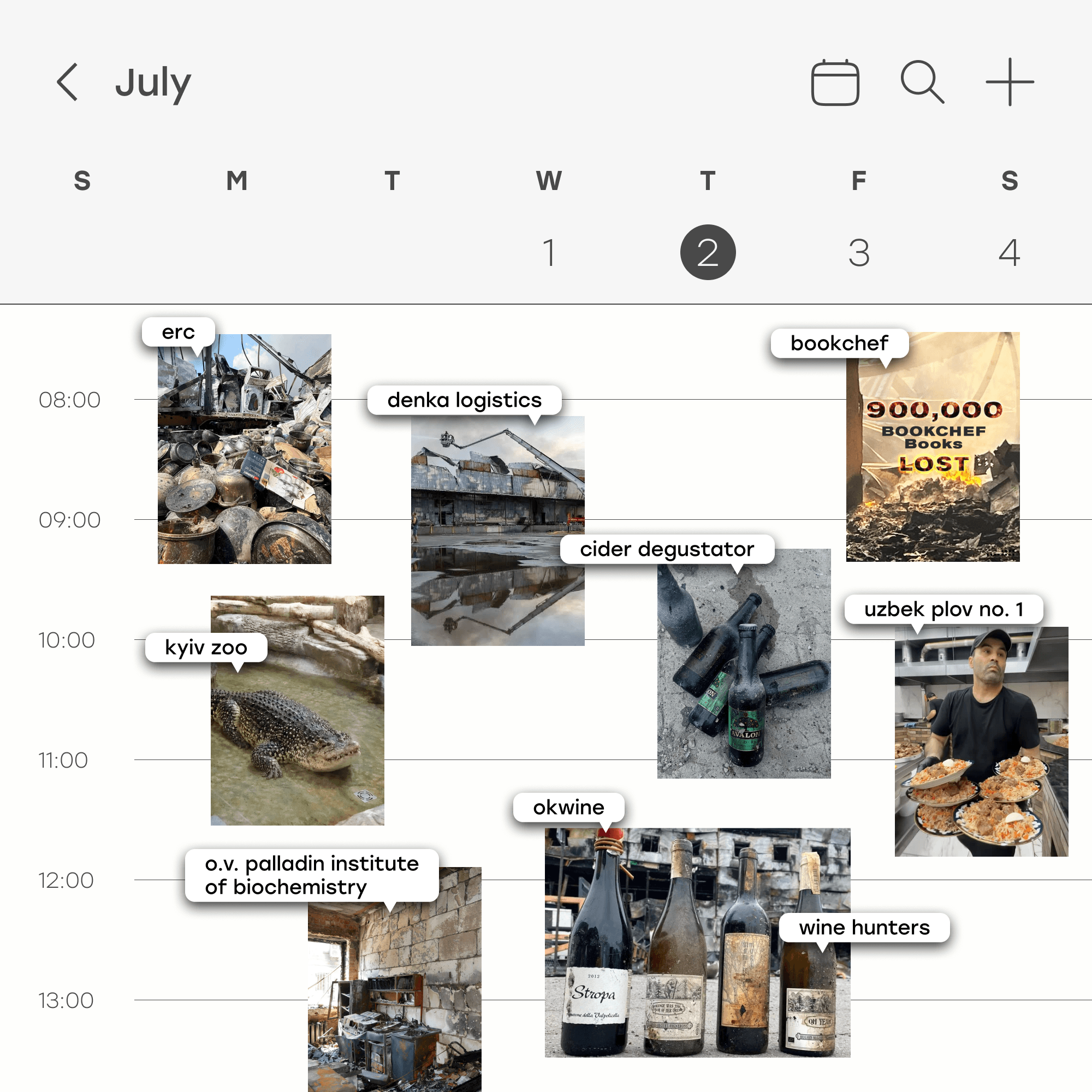
On July 2, ballistic missiles struck the Kyiv warehouse of ERC, one of Ukraine’s largest distributors of computer equipment and home appliances. The building caught fire and completely collapsed. The only things left intact were the thuja trees growing in pots outside the warehouse. Within several days of the attack, ERC rented a new warehouse and began rebuilding its lost product range.
That same night, a missile hit a Denka Logistics warehouse outside Kyiv. Around 800,000 books published by BookChef burned, along with goods from cider importer Cider Degustator and wine distributors OKWINE and Wine Hunters. Cider Degustator lost its entire stock for the second time: in April 2025, the company’s warehouse had already burned down after a Shahed drone attack.
The same attack destroyed a restaurant of the Uzbek Plov No. 1 chain in Kyiv and damaged buildings at the Kyiv Zoo, as well as exotic plants in its winter garden. Shattered glass and pieces of window frames fell onto turtles and crocodiles, so the animals needed veterinary care.
Jet-powered drones struck the O.V. Palladin Institute of Biochemistry, one of Ukraine’s oldest research institutions. The attack damaged a building and laboratories where scientists were developing new methods to stop bleeding and prevent thrombosis. The drones destroyed scientific equipment and biological samples needed for research. The institute estimates its losses at $1.3 million to $1.7 million.
Overnight into July 1, Russia leveled the warehouses and office premises of two meat-processing companies, MHP and Yuvileinyi, in Zaporizhzhia, with Shahed drones. The attack also wrecked the main production and logistics hub of hygiene products brand Snizhna Panda in the Odesa region, where household goods and toilet paper were manufactured. Several employees were injured.