
Yuliia Konarieva and Artur Konariev are a Ukrainian couple who moved to London, Canada, in 2023. There, Artur, who had long been interested in coffee, began experimenting with roasting beans. That is how the brand Hutsul Coffee Factory was born, and today its products are sold in local stores and at its own coffee shop, Hutsul Coffee Space, where Canadians are introduced not only to specialty coffee but also to Ukrainian culture.
Yellow Blue journalist Sofiia Korotunenko spoke with Artur Konariev about building a coffee business in Canada, introducing locals to Ukrainian culture, and teaching them to appreciate drip coffee, Napoleon cake, and poppy seed buns.
1
What did you do before starting your own business?
I was a product designer, and Yuliia worked in graphic design and managed one of the Lviv Handmade Chocolate shops in Kyiv. We traveled a lot around Europe, spending several months each in Germany, Spain, and Austria. We had been considering a move to Poland for a long time, and in 2021 we relocated to Krakow.
That was where Russia's full-scale invasion of Ukraine caught up with you, and where you began helping Ukrainian refugees. Could you tell us more about that experience?
Ukrainians were at a loss, and we wanted to help however we could. Together with Polish friends, we created an organization called Kocham Dębniki. We met Ukrainians at the train station, took them to Polish families' homes or hotels, and helped find food, clothing, blankets, medicine, and other basic necessities. We also sent vans carrying humanitarian aid to frontline regions and to soldiers at the front.
In June 2022, we opened a refugee assistance center. We organized Polish and English language courses, helped people navigate paperwork, and assisted them in opening bank accounts. The center also operated a daycare facility so parents could leave their children under supervision while they were at work or running errands.
Soon afterward, you moved to Canada and founded the brand Hutsul Coffee Factory in December 2023. How did that come about?
Even while we were traveling around the world, we realized that we would like to live in Canada someday. We chose London because it has a comfortable climate, with all four seasons and winters that are not too harsh.
I love good coffee and have long been interested in alternative ways to brew it. Almost all the coffee beans available in Canada are roasted Dark. It is bitter coffee that is simply impossible to drink. I started studying different roasting methods, and eventually that interest grew into a coffee brand.
You had not worked in the coffee business before. How long did it take to learn the production process?
Before launching the business, we studied how coffee beans are processed, fermented, and roasted in Ukraine, because Ukrainian brands make coffee that genuinely tastes good. We experimented a lot with roasting technologies and developed a roasting profile for each variety of beans: a detailed guide to bringing out its best flavor. We tested different temperatures, measured moisture levels, and removed the protective outer layer from some varieties of beans. That gives the coffee new flavor notes.
Once we started getting good results, we asked friends and colleagues to taste our coffee. Later, we offered samples to visitors at local markets, pop-up events where small businesses set up stalls. We saw that people liked it, and that encouraged us to keep going.
How does your production process work?
We roast our coffee using our partners' facilities at KW Coffee Collective. Canada has regulations that allow businesses to operate only government-approved equipment, specifically roasters made by American manufacturers rather than Chinese ones. Depending on their size, such roasters cost between $20,000 and $50,000.
Under the same regulations, a roaster can only be installed in an industrial zone. The facility must have a dedicated electrical line, gas connection, and ventilation system. In addition, an inspector must verify that the equipment operates safely before issuing a license. All of this costs tens of thousands of dollars more and can take anywhere from several months to a year. That is why it is far more cost-effective for us to roast coffee using our partners' equipment.
We rent a warehouse where we store our products. We also package them there in food-grade nitrogen using specialized equipment, keeping freshly ground coffee fresh. We make our drip coffee by hand, but in the future we want to launch a production line for it, along with our own roasting and automated packaging operations.
What is coffee culture like in Canada? How competitive is the industry?
I would say that Canada is still stuck in the 1990s and early 2000s when it comes to both coffee preparation and consumption habits. People usually buy bitter coffee made from over-roasted beans at drive-throughs, add large amounts of sugar or flavored syrups to mask the bitterness, and drink it while driving.
Canadians have been drinking coffee from their favorite brands for years, so it is not easy for new companies to earn their trust. At the same time, we see growing interest in new formats such as drip and specialty coffee. In 2025, we opened our own coffee shop in London called Hutsul Coffee Space. We invite visitors to try coffee brewed in ways that are new to them. Quite often they enjoy it and come back for more.
We want to show Canadians that coffee can be savored rather than swallowed like a stimulant pill. On our website, we describe the beans' country of origin and processing method, and explain how these factors affect acidity, bitterness, strength, and aroma. This helps people start with varieties closer to what they already know.
You also sell tea and honey from Ukraine. Which Ukrainian businesses do you work with? Is there demand for these products?
We source them from local producers in Vorokhta and Verkhovyna. They have formed a small cooperative to sell honey and teas made from dried berries and herbs, and they send us small parcels of up to 10 kilograms through Ukrposhta.
Shipping ends up costing twice as much as the products themselves, so we cannot place orders very often. However, there is strong demand for organic products in Canada. Right now, we are looking for a regional manager in Ukraine who can organize regular shipments of larger quantities that would justify the shipping costs.
How do you promote your brand in Canada?
We work on several fronts. We promote our website and social media channels while also expanding our network of offline partners both within Canada and internationally. These include restaurants, offices, retail stores, and coffee shops. Hutsul Coffee Space has also worked well, giving people a chance to experience our brand in person.
We are planning to build a community of coffee enthusiasts through an online platform called Coffee Adventure Club, where people will be able to share their impressions of our coffee. To keep members engaged, we plan to hold monthly giveaways and release our own merchandise.
Your packaging carries the label "woman-owned company." Does that help promote the brand?
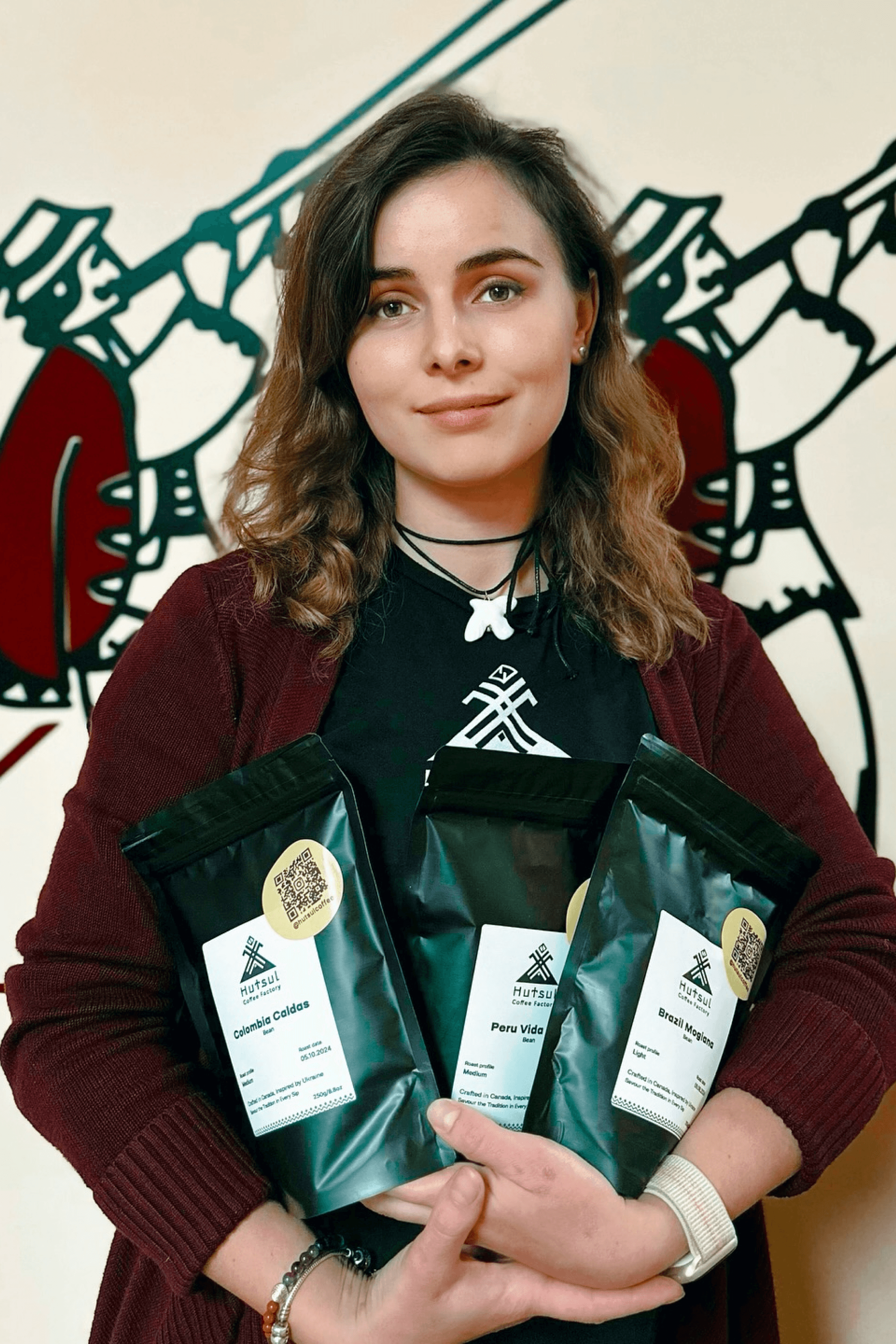
This matters in Canada because it is an inclusive country that fights discrimination. Yuliia handles a large part of our business, and there are areas, like our social media, that she runs entirely on her own.
Do you think you have established yourselves in the local market over these three years?
Every month we see growing interest in our brand, partly because we promote Ukrainian history and culture. Canada is a country of immigrants, and people here are curious about their own heritage and the cultures of others.
We now work with stores, coffee shops, and offices across different provinces, sell coffee through our website, and ship orders to every corner of Canada, from British Columbia to the Arctic coast.
Our products are available at Kolo Cafe in Toronto, Malina Ukrainian Bakery in Edmonton, and the health food store Quarter Master Natural Foods. Our next step is to reach supermarket chains and access a wider audience.
You mentioned earlier that Canadians are conservative consumers. Are the businesses you work with, landlords, store owners, distributors in large supermarket chains, also cautious about new brands?
Yes, especially when it comes to small businesses, because larger players can offer high volumes and big money. Canadians are so conservative that when we were starting out, almost no one wanted to rent us warehouse space. They told us to come back in three years, if our business was still around by then.
Personal connections work best, which is why breaking into supermarkets has been difficult for us. We are looking for people who can connect us with the buyers who stock large chains. Even once we reach them, we will need to go through many levels of approval, fill out numerous forms, and verify documentation before they can make any decision at all.
Canada is a country of bureaucrats: there is always a great deal of paperwork. I understand that it ensures safety, but it also creates additional obstacles for small businesses that need to move quickly and flexibly.
2
In January 2025, you opened Hutsul Coffee Space. How did that idea come about?
Promoting coffee culture online alone is difficult. Aroma and taste cannot be conveyed through a screen. Besides, customers cannot make coffee at home the way we do. That is why our own coffee shop is the perfect way to introduce people to our brand.
The space also draws visitors into Ukrainian culture. We covered the tables with embroidered tablecloths and crocheted doilies, decorated the walls with portraits of well-known figures such as Solomiya Krushelnytska, Taras Shevchenko, and Lesya Ukrainka. Canadians often ask who they are, and that gives us an opportunity to talk about our culture, history, and present day.
We also host regular events. We invite stand-up comedians, Ukrainian bands, and local performers, organize board game nights, and hold meetings of a women's community that supports female entrepreneurs with legal and financial advice, as well as fresh ideas. We arrange educational talks for Ukrainians on topics such as taxes in Canada, and charity evenings to raise funds for the Ukrainian armed forces.
Both your brand and coffee shop include the word "Hutsul" in their names. Hutsuls are an ethnic group native to the Ukrainian Carpathians. Why did you choose that name?
There is a large Ukrainian diaspora here, descended from people who immigrated in the nineteenth and twentieth centuries from the western regions of Ukrainian lands, where Hutsuls have historically lived. Foreigners often ask what the word means, and that creates another opportunity to talk about Ukraine and a starting point for exploring our culture. Many do not know how to pronounce "Hutsul," so we printed a phonetic guide in our menu.
How much does it cost to open a coffee shop in London?
It is difficult to give an exact figure, but approximately $7,000. We did not have substantial savings, so we handled the renovation ourselves, transported and installed the equipment and furniture. We keep improving it and reinvesting part of our profits.
We learned as we went along, and if we open another location, there are many things we would do differently. Right now, we are considering launching a franchise. Several people have already expressed interest in opening coffee shops under our brand in other Canadian cities.
Do you receive any government support, such as grants?
In October 2025, we received a grant from London's Small Business Center, an organization that advises and financially supports small businesses. It was a long and complicated bureaucratic process, but in the end we received $5,000 and purchased a packaging machine. In Canada, immigrants are not restricted from participating in grant programs. The only requirement is having a registered business in the country.
You mention on social media that you serve Ukrainian desserts. Tell us more about that.
Yes, visitors can enjoy a cup of coffee with popular Ukrainian desserts such as medovyk, Napoleon cake, or sweet buns filled with poppy seeds or cherries. These treats are difficult to find in Canada. Even sour cherries are hard to come by because people here mostly eat sweet cherries. Canadians enjoy trying new flavors, and many of them buy several buns to take home for their families.
We also welcome descendants of Ukrainian immigrants in the third and fourth generations. They may not speak Ukrainian, but they remember the pastries their grandmothers used to make. These encounters are always emotional. People recall their relatives and childhood memories, often with tears in their eyes.
Are most of your visitors members of the Ukrainian diaspora or foreigners?
During our first year, most of our visitors were Ukrainians. Today, the ratio is about 60 to 40, with more Canadians coming in. For them, we are both a destination connected to Ukrainian history and a small adventure. Our coffee shop is not particularly easy to find, and we do not have a drive-through. We even receive coffee enthusiasts from other provinces, including Toronto and Vancouver, people looking for places where coffee is not roasted dark and where baristas use alternative brewing methods.
Do you think you are managing to promote both coffee and Ukrainian culture in Canada?
Yes. Some Canadians are skeptical and ask how our coffee differs from theirs. We tell them about our background, Ukrainian roasting methods, alternative brewing techniques, and then invite them to taste the coffee. That openness always works. People open up in return.
Locals are often surprised by the facts we share about Ukraine. For example, they learn about Ihor Sikorsky, who created the helicopter, about "Shchedryk", which they know as Carol of the Bells, and about the painters Ivan Aivazovsky and Kazimir Malevich. I think we spark their curiosity and give them something to discuss with friends. That is what matters most to us.
At the same time, there are still people here who do not see a difference between Ukraine and Russia, or who continue to view Ukraine only as a former part of the Soviet Union and the Russian Empire. Canada has a large Russian community, and a lot of Russian propaganda with it. In major supermarkets, Russian products are often sold alongside Ukrainian ones under the shared label "Slavic products."
We have met several Canadians who were wary of Ukraine, and some of them changed their minds after speaking with us. We do everything we can. We promote Ukrainian culture and help locals understand that Ukraine is an independent country with its own history, culture, inventions, and artistic heritage.
3
Apart from bureaucracy, what other challenges have you faced as entrepreneurs in Canada?
Right now, our biggest challenge is promoting the business and getting our name out there. We are looking to build relationships with new partners, including coffee shops, supermarkets, and restaurants. We would also like to work with offices. People spend eight hours a day at work and, naturally, they drink coffee. Securing these kinds of partnerships is difficult, though, because Canadian businesses are not particularly open to new suppliers.
How do you see the future of Hutsul Coffee Factory and Hutsul Space?
We want to continue developing Hutsul Space as a cultural center and host more events there. We also plan to expand our coffee selection, scale up our drip coffee business, and enter new markets in the United States and, if possible, Europe.
One of our immediate goals is to establish a drip coffee production line to automate the process and cut costs. To make that happen, we plan to launch a crowdfunding campaign on Kickstarter. We believe drip coffee is a promising segment that will help us enter new retail channels and reach new markets.
In your opinion, what is important for people to know if they want to start a coffee business?
Coffee prices continue to rise, partly because of climate change. Harvests are being damaged by extreme heat and by insects, whose populations have increased due to warming temperatures. As a result, farmers are producing smaller batches under more challenging conditions and have to move their crops higher into the mountains.
It is also important to understand not only climate-related factors but political developments around the world as well. Prices can be affected by a poor harvest in Brazil caused by drought, as well as by local protesters blocking ports.
And there are factors that simply cannot be predicted. For example, in 2025, pirates stole our coffee. We ordered beans from Ethiopia, and the vessel transporting them passed through waters near Somalia. Pirates held the ship hostage for about six months and demanded a ransom of several million dollars from its owners. We do not know exactly how the shipping company resolved the situation, but eventually the coffee reached us.
What are the key lessons you have learned over these three years?
We Ukrainians are energetic by nature and want to enter a new market fast, but Canada prefers a slower pace. You need to adapt to the local culture and be patient. Do not be afraid to ask for help, not only from fellow Ukrainians and Canadians, but from authorities too. They are open to local businesses and appreciate them.
If you have a quality product and believe in it, you need to speak up. A friend of ours in St. Thomas makes varenyky. Local residents loved them so much that they raised money to help her grow her business, rent a facility, and expand production. She put herself and her product out there, and people supported her. It is not enough to create something great. You also have to tell people about it.


